
Have you ever seen a job post that asks for a working knowledge of Excel, Word, or another skill? You may know the basics, but you might wonder how much experience the employer expects.
The phrase working knowledge describes more than simply knowing that something exists. It means you understand a subject well enough to use it in real situations. You may not be an expert, but you can handle common tasks without needing someone to guide you through every step.
For example, a person with a working knowledge of Microsoft Excel can enter data, use simple formulas, and create basic tables. They may not know advanced functions or complex data tools.
In this guide, you will learn the working knowledge meaning, how people use this phrase, and what it means in job descriptions, education, and daily life. You will also see clear examples and learn how working knowledge differs from basic knowledge and expertise.
Quick Answer: What Does Working Knowledge Mean?
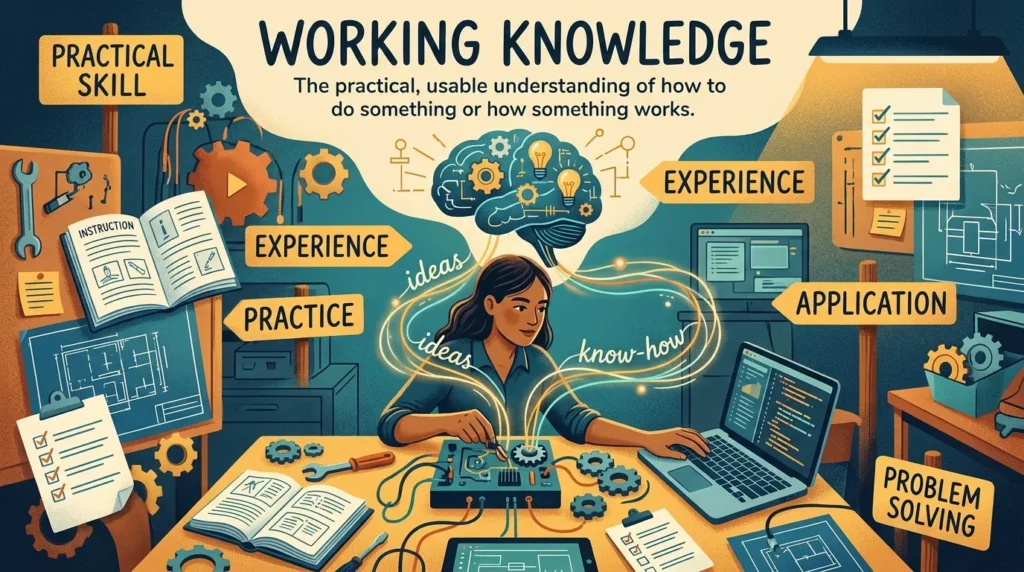
Working knowledge means having enough understanding and practical skill to use a subject, tool, or process in everyday tasks.
It does not mean you know everything about that subject. It means you can use what you know to complete common tasks, solve simple problems, and work with some level of independence.
For example, working knowledge of English means you can understand and use English in common conversations, even if you are not fluent.
Working Knowledge Definition and Meaning
A working knowledge is a useful level of understanding that helps a person perform tasks in a particular field.
It combines two important things:
- Understanding: You know the basic ideas, rules, and terms related to a subject.
- Practical use: You can apply that knowledge to real tasks.
Consider someone who has a working knowledge of Microsoft Word. They can write documents, change fonts, add headings, insert pictures, and save files. They may not know every advanced feature, but they can use the program for normal work.
In simple words, working knowledge means knowing enough to get the job done.
It often appears in professional settings because employers want people who can use a tool or skill without needing full training from the start.
What Does Working Knowledge Mean in a Job Description?
When an employer uses the phrase working knowledge in a job description, they usually want someone who can perform common tasks with a particular tool, system, or subject.
They do not always expect expert-level skills. However, they want more than someone who has only read about the subject.
For example, consider this job requirement:
Applicants must have a working knowledge of Microsoft Excel.
This means you should be able to use Excel for normal work tasks. You may need to enter information, organize data, use simple formulas, and make basic spreadsheets.
You should also know how to complete these tasks without asking for help at every step.
The exact level depends on the job. A simple office role may require basic spreadsheet skills, while an accounting role may require more advanced skills.
The University of Texas at Arlington also describes working knowledge as enough familiarity with a subject to understand its basic principles and solve simple problems.
What Employers Expect From Working Knowledge
An employer may expect you to:
- Understand common terms and basic rules.
- Use the required tool or skill for normal tasks.
- Follow standard steps and instructions.
- Solve simple problems on your own.
- Know when you need help with a complex task.
- Learn more advanced skills as the job requires.
Important: Working knowledge does not mean you can handle every possible task. It means you have enough practical knowledge to perform the usual duties of the role.
10 Working Knowledge Examples in Everyday Life
The best way to understand this phrase is to look at real-life examples.
Working knowledge can apply to computer programs, languages, business tools, and many other subjects. Here are ten simple examples.
1. Working Knowledge of Microsoft Excel
A person with working knowledge of Excel can enter data, create tables, format cells, and use simple formulas.
For example, they can make a monthly expense sheet and calculate the total cost.
They may not know advanced formulas, macros, or complex data analysis.
2. Working Knowledge of Microsoft Word
This means you can create and edit documents with Word.
You know how to change fonts, adjust page layouts, add headings, insert pictures, and save files.
You can prepare common office documents without needing full guidance.
3. Working Knowledge of English
A person with a working knowledge of English can understand common words and use the language in everyday situations.
They may take part in simple conversations, read basic messages, and explain their ideas.
However, they may still make grammar mistakes or struggle with complex discussions.
4. Working Knowledge of SEO
Someone with working knowledge of search engine optimization understands basic SEO practices.
They may know how to:
- Find relevant keywords.
- Write SEO titles and meta descriptions.
- Add internal links.
- Use heading tags.
- Improve page content.
- Check basic search performance.
They may not have deep skills in technical SEO, large-scale site audits, or advanced analytics.
5. Working Knowledge of HTML
A person with working knowledge of HTML can create and edit simple web page elements.
They may know how to add headings, paragraphs, links, images, and lists.
They can make basic changes to a page but may need help with complex code.
6. Working Knowledge of Accounting
This means you understand common accounting terms and can handle simple financial tasks.
For example, you may record expenses, organize receipts, prepare basic reports, and understand the difference between income and costs.
You may still need an accountant for complex tax or financial matters.
7. Working Knowledge of Social Media
A person with working knowledge of social media can use common platforms for communication or business.
They may know how to publish posts, upload pictures, reply to comments, and check basic engagement.
They may not know advanced advertising or audience analysis.
8. Working Knowledge of Programming
This means you understand basic programming ideas and can write or edit simple code.
For example, you may know how to use variables, conditions, loops, and functions.
You can complete small coding tasks but may need help with complex software projects.
9. Working Knowledge of Photoshop
A person with working knowledge of Photoshop can crop pictures, adjust colors, remove simple backgrounds, and add text.
They can make basic image edits for websites or social media.
They may not have advanced skills in photo manipulation or professional design.
10. Working Knowledge of Project Management
This means you understand how to plan tasks, set deadlines, track progress, and communicate with team members.
You can help manage a small project and keep its main tasks organized.
You may not have the experience needed to manage large or complex projects.
Working Knowledge vs. Basic Knowledge vs. Expert Knowledge
These terms describe different levels of understanding and practical ability.
Knowing the difference can help you understand job requirements and describe your own skills more clearly.
| Knowledge level | What it means | Simple example |
| Basic knowledge | You understand the main ideas but may need help using them. | You know what Excel does but have little practice. |
| Working knowledge | You can use the subject for common tasks. | You can create spreadsheets and use simple formulas. |
| Good working knowledge | You can handle a wider range of normal tasks with confidence. | You can organize data and solve common spreadsheet problems. |
| Expert knowledge | You have deep skills and can handle complex problems. | You can build advanced spreadsheets and help others solve difficult issues. |
Is Working Knowledge the Same as Practical Knowledge?
They are closely related, but they do not always mean exactly the same thing.
Practical knowledge means knowledge gained or used through real tasks and experience.
Working knowledge means enough understanding and practical ability to use a subject for normal tasks.
For example, you may have practical knowledge of cooking because you prepare meals every day. You may also have a working knowledge of kitchen safety because you understand how to handle common tools and follow basic safety rules.
The main difference is the focus. Practical knowledge highlights real-world experience, while working knowledge highlights the ability to use what you know.
Good Working Knowledge: What Does It Mean?
The phrase good working knowledge suggests a useful and confident level of understanding.
It often means you can handle many common tasks without much help.
For example, a job post may say:
Candidates should have a good working knowledge of Google Workspace.
This may mean you should know how to use Google Docs, Sheets, Drive, and Gmail for everyday work.
You should also be able to complete common tasks, share files, and work with others.
However, the word “good” does not create one fixed skill level. Each employer may use it in a different way.
You should always read the duties and requirements around the phrase to understand what the employer expects.
How to Develop a Working Knowledge of Any Subject
You do not need to become an expert to gain working knowledge. You need to learn the main ideas and practice the tasks that people use most often.
Here are six useful steps.
1. Learn the Basic Terms
Start by learning the words and ideas linked to the subject.
For example, if you want working knowledge of SEO, learn keywords, search intent, title tags, internal links, and indexing.
These basic terms will help you understand more advanced lessons.
2. Focus on Common Tasks
Do not try to learn every feature at once.
Find out what people use most often and start there.
If you are learning Excel, practice entering data, making tables, using SUM, and sorting information.
These tasks give you a useful starting point.
3. Practice With Real Examples
Reading about a subject is helpful, but practice builds your ability to use it.
For example, create a real monthly budget in Excel instead of only watching Excel tutorials.
If you are learning HTML, build a simple web page.
Real tasks help you see how your knowledge works outside a lesson.
4. Solve Simple Problems
Try to complete small tasks without following a tutorial every time.
If something goes wrong, find the cause and try to fix it.
This helps you build confidence and understand the subject more deeply.
5. Ask for Feedback
Ask someone with more experience to review your work.
They may notice mistakes or show you a better way to complete a task.
Feedback can also help you understand which skills you need to improve.
6. Test Your Skills
Give yourself a small task and try to complete it without help.
For example, create a spreadsheet, write a short document, or build a simple web page.
If you can complete common tasks and explain what you are doing, you may have developed a working level of knowledge.
How to Describe Working Knowledge on a Resume
You can use the phrase working knowledge on your resume when you can genuinely use a tool or skill for common tasks.
The best approach is to name the skill and explain what you can do with it.
Avoid listing skills just because you have heard of them. An employer may ask you to demonstrate your ability during an interview.
Here are some examples:
Example 1: Computer skills
“Working knowledge of Microsoft Word, Excel, and PowerPoint.”
Example 2: Digital marketing
“Working knowledge of SEO, keyword research, and on-page optimization.”
Example 3: Language skills
“Working knowledge of English for everyday written and spoken communication.”
Example 4: Web development
“Working knowledge of HTML and CSS for basic website editing.”
Example 5: Office work
“Good working knowledge of Google Workspace and common office tools.”
Should You Write Working Knowledge or Proficient?
Choose the phrase that best matches your real ability.
Use working knowledge if you can complete common tasks but still need to learn advanced features.
Use proficient if you can use the skill confidently across a wider range of tasks.
Be honest about your level. A clear and truthful resume is better than a list of skills you cannot demonstrate.
Working Knowledge: Comparison of Common Mistakes and Correct Usage
People sometimes misunderstand this phrase and use it in the wrong way.
The following table shows common mistakes and how to understand the term correctly.
| Common mistake | Correct understanding |
| Working knowledge means expert knowledge. | It means enough skill to handle common tasks. |
| Reading one article gives you working knowledge. | You also need enough practice to use the subject. |
| You must know every feature. | You need to understand the features required for normal tasks. |
| Working knowledge means you never need help. | You may still need help with complex problems. |
| It means the same thing in every job. | The required level depends on the role and duties. |
| You can claim it without testing your skills. | You should be able to show what you can actually do. |
Working Knowledge: Quick Reference Checklist
Use this checklist to decide whether you have working knowledge of a particular subject or skill.
| Skill check | What you should be able to do |
| Understand the basics | Explain the main ideas and common terms. |
| Complete common tasks | Perform normal tasks without constant guidance. |
| Use the right tools | Work with the tools or systems used in that field. |
| Solve simple problems | Handle common issues using what you know. |
| Apply your knowledge | Use your skills in real situations. |
| Recognize your limits | Know when a task needs expert help. |
| Keep learning | Improve your skills through practice and feedback. |
If you can meet most of these points, you may have a working level of knowledge. The exact requirements still depend on the subject and the work you need to perform.
Common Phrases That Use Working Knowledge
You may see this phrase in job posts, professional emails, interviews, and everyday conversations.
Here are some common examples and what they mean.
- Working knowledge of computers: You can use common computer programs and perform everyday tasks.
- Working knowledge of a language: You can understand and communicate in common situations.
- Working knowledge of business: You understand basic business ideas and can apply them to normal tasks.
- Working knowledge of software: You can use the software for its main functions.
- Working knowledge of a subject: You understand its basic principles and can use that knowledge in practice.
- A sound working knowledge: You have a reliable understanding that helps you perform common tasks.
- A good working knowledge: You can handle a useful range of tasks with confidence.
The words around the phrase can give you more information about the level a speaker expects.
Is Working Knowledge a Skill or a Level of Knowledge?
Working knowledge is best understood as a level of knowledge that includes practical ability.
It is not one specific skill. Instead, it describes how well you understand and use a particular subject.
For example, Excel is a skill or tool. Working knowledge of Excel describes your ability to use it for everyday tasks.
The same idea applies to languages, software, business, marketing, and other fields.
You can gain this level through study, training, practice, or work experience. You do not always need a formal certificate to develop it.
Why Is Working Knowledge Important?
Working knowledge helps people turn what they learn into useful action.
A person may understand a subject in theory but struggle to use it in real situations. Practical ability helps close that gap.
It is useful for several reasons:
1. It helps you work independently. You can complete common tasks without asking someone to explain every step.
2. It improves your confidence. You feel more comfortable using tools and applying your skills.
3. It supports career growth. Employers often look for people who can use their knowledge to perform job duties.
4. It saves time. You can handle familiar tasks without needing constant training.
5. It helps you find skill gaps. You can see what you know and what you still need to learn.
Working knowledge also gives you a strong base for further learning. Once you understand the main ideas and can use them, you can move toward advanced skills.
FAQs:
1. What is the simple meaning of working knowledge?
Working knowledge means knowing enough about a subject to use it for everyday tasks. You understand the basic ideas and can apply them in real situations. You do not need to be an expert.
2. Does working knowledge mean beginner level?
Not exactly. It is usually above simple awareness or beginner-level understanding. You should have enough practice to handle common tasks, even if you still need help with advanced work.
3. What is an example of working knowledge?
A person who can use Excel to enter data, create tables, and calculate totals has working knowledge of Excel. They can complete common tasks without knowing every advanced feature.
4. What does working knowledge mean on a resume?
On a resume, it means you can use a particular skill, tool, or subject for normal work duties. For example, working knowledge of HTML means you can make basic changes to web pages using HTML.
5. Is working knowledge better than basic knowledge?
Yes, in terms of practical ability. Basic knowledge means you understand the main ideas. Working knowledge means you can also use those ideas to complete common tasks.
6. How much experience do you need for working knowledge?
There is no fixed number of months or years. The time depends on the subject, its difficulty, and how often you practice. Some people gain working knowledge in a short time, while others need longer.
7. What is the difference between working knowledge and expertise?
Working knowledge means you can handle common tasks and solve simple problems. Expertise means you have deeper skills and can deal with complex problems, guide others, and make informed decisions in that field.
Conclusion:
The working knowledge meaning is simple: you know enough about a subject to use it in real situations. You do not need to know every detail or become an expert.
This phrase often appears in job descriptions, resumes, education, and professional conversations. It tells you that someone expects you to understand the basics and perform common tasks with some independence.
If you want to develop working knowledge, focus on basic ideas, practice real tasks, and learn from your mistakes.
Most importantly, be honest about your skills. It is better to have real working knowledge than to claim expertise you cannot show.

Hey, I am passionate about exploring the meanings of English words and helping people understand language in a simple way. I enjoy researching word definitions, discovering different meanings, and explaining how words are used in everyday conversations. At Publarex.com, I focus on creating easy-to-understand explanations of words, slang, phrases, and expressions. I believe that knowing the meaning of a word is important for better communication and learning. My goal is to help readers find accurate information, expand their vocabulary, and understand English with confidence.