
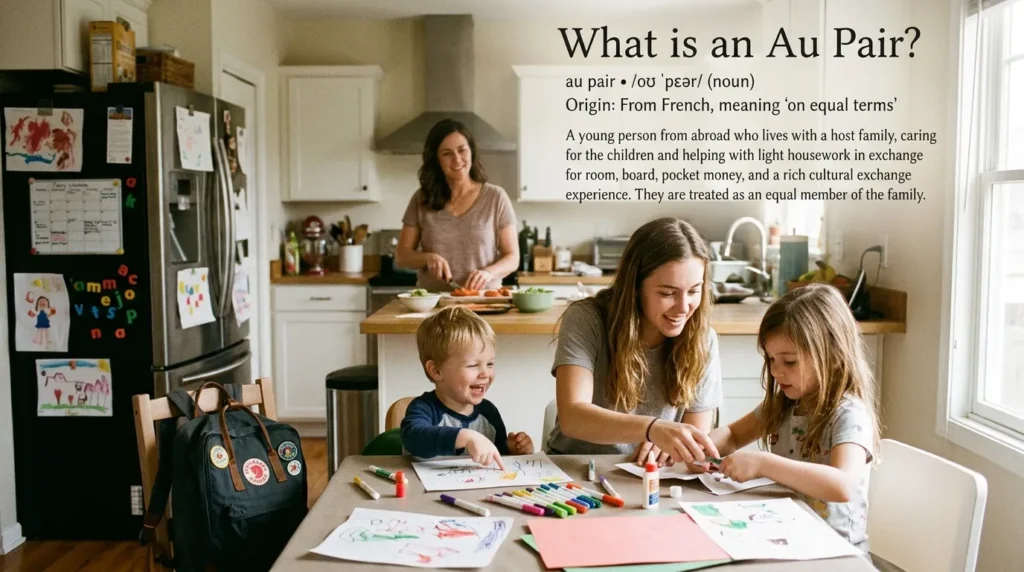

Have you ever heard someone say that a family has an au pair and wondered what that means? You may see this term in job ads, travel stories, or conversations about childcare. Although it may sound like an unusual phrase, its meaning is quite simple.
The term au pairs refers to young people who live with a host family and help care for its children. In return, they usually receive a place to stay, meals, and some money. They may also get the chance to learn a new language and experience life in another country.
The phrase comes from French and has a special idea behind it: an exchange between people on equal terms.
In this guide, you will learn the au pairs meaning, its origin, common duties, and how an au pair differs from a nanny or babysitter. You will also find easy examples, common uses, and answers to questions people often ask about this term.
Quick Answer: What Does Au Pairs Mean?
Au pairs means young people who live with a host family and help look after the family’s children in exchange for room, meals, and a payment or allowance. The arrangement often includes cultural exchange, language learning, and sharing daily family life.
An individual is called an au pair, while au pairs is the plural form.
Au Pair Definition and Meaning in English
An au pair is a person who lives with a family, often in another country, and helps care for its children.
The family provides a room, food, and agreed payment. The au pair helps with tasks linked to the children, such as preparing their meals, playing with them, and taking them to school.
This arrangement is different from a normal job because it often includes cultural learning. The au pair gets to experience a new way of life while helping the family.
Here is a simple way to understand the term:
- Au pair: One person who lives with a family and helps care for its children.
- Au pairs: Two or more people who have this role.
- Host family: The family that welcomes an au pair into its home.
- Cultural exchange: Learning about another country’s language, food, and daily life.
For example:
“Sarah worked as an au pair in France for one year.”
This means Sarah lived with a French family and helped care for its children.
Where Does the Term Au Pair Come From?
The term au pair comes from the French language.
It means “on equal terms” or “on an equal footing.” This meaning points to the idea of an exchange between the au pair and the host family.
The family offers a place to live, meals, and other agreed benefits. In return, the au pair helps with childcare and takes part in family life.
The term became part of English through this type of living arrangement. It is now used in many countries.
The phrase does not mean a married couple or two people who look after each other. It describes a childcare and cultural exchange arrangement.
What Does an Au Pair Do?
An au pair mainly helps a family with childcare. Their daily tasks depend on the children’s ages and the agreement with the host family.
Some au pairs help in the morning before school. Others care for children in the afternoon or during certain evenings.
Common duties include:
1. Looking After Children
The main job is to keep children safe and care for their daily needs.
An au pair may watch children at home, help them get ready, or stay with them while their parents are busy.
2. Preparing Children’s Meals
An au pair may prepare simple meals and snacks for the children.
For example, they might make breakfast, pack a school lunch, or prepare an afternoon snack.
3. Helping With Schoolwork
Some au pairs help children with basic homework or reading.
They may also help children practice a language if both sides agree to it.
4. Taking Children to Activities
An au pair may walk or drive children to school, sports, or other activities.
Driving duties depend on the person’s driving skills, local rules, and the agreement with the family.
5. Playing and Learning Together
Playing is an important part of childcare.
An au pair may read stories, play games, draw pictures, or take children to a park.
6. Helping With Children’s Rooms
Some child-related household tasks may be part of the role.
These can include putting away toys, washing children’s clothes, or cleaning up after their meals. General house cleaning is not the same as childcare.
The U.S. Department of State’s rules describe the role as childcare within a cultural exchange program.
Au Pair vs Nanny: What Is the Difference?
People often use the words au pair and nanny when talking about childcare. However, they do not mean exactly the same thing.
An au pair often lives with a host family as part of a cultural exchange. A nanny usually works as a paid childcare professional and may live inside or outside the family’s home.
Here are the main differences:
| Feature | Au Pair | Nanny |
| Living place | Often lives with the family | May live in or out |
| Main role | Childcare and cultural exchange | Professional childcare |
| Background | Often from another country | Can be from any country |
| Payment | Often receives a stipend | Usually receives a wage |
| Work arrangement | Often follows an exchange program | Usually follows an employment agreement |
| Main goal | Childcare and cultural learning | Childcare and family support |
Example:
- “We hired a nanny to care for our baby.” This means the family hired a childcare worker.
- “We welcomed an au pair from Spain.” This means the family welcomed someone from Spain who will live with them and help care for their children.
The key difference is that an au pair arrangement often combines childcare with cultural exchange. A nanny’s main role is professional childcare.
What Is an Au Pair Program?
An au pair program helps connect young people with families in another country.
The person lives with a host family and helps care for its children. In return, the family provides agreed living benefits and payment.
These programs can give people a chance to experience another culture while gaining childcare experience.
In the United States, the au pair program is part of the Department of State’s Exchange Visitor Program. It uses the J-1 exchange visitor visa.
Under the U.S. federal program rules:
- Participants must meet the program’s age requirements.
- They live with an approved host family.
- They provide childcare within set limits.
- They must take part in an educational program.
- The sponsor helps support and monitor the exchange.
The standard U.S. program allows up to 45 hours of childcare per week. Participants must also complete at least six semester hours of academic credit or an equivalent course of study.
These are U.S. program rules. Other countries may have different age limits, visas, payment rules, and work conditions.
Do Au Pairs Get Paid?
Yes, au pairs usually receive money for their childcare work.
However, the payment system can differ from a normal job. Some programs use a weekly stipend, while other countries may have different payment arrangements.
The host family may also provide:
- A private bedroom
- Daily meals
- Time off
- Paid vacation, where required
- Help with agreed education costs
- Access to family activities
In the United States, the payment and working conditions follow the rules of the applicable exchange program and other relevant laws.
It is important to understand that room and meals do not automatically replace payment. The family and au pair should understand the rules before the arrangement starts.
Who Can Become an Au Pair?
The exact requirements depend on the country and the program.
Many programs look for young adults who enjoy working with children and want to learn about another culture.
Common requirements may include:
- Meeting the program’s age limit
- Having childcare experience
- Speaking or learning the host country’s language
- Having a valid passport
- Passing required background checks
- Meeting health and education requirements
- Having the skills needed for the agreed childcare tasks
For example, the U.S. exchange program has specific age, education, childcare, and visa requirements. A person should check the rules of an approved sponsor before applying.
Benefits of Being an Au Pair
Working as an au pair can offer more than a place to live and childcare experience.
Here are some common benefits.
1. Learn a New Language
Living with a family in another country gives an au pair a chance to practice the local language every day.
They can learn new words through normal conversations, shopping, and daily activities.
2. Experience a New Culture
An au pair may learn about local food, family habits, holidays, and traditions.
This can help them understand how people live in another part of the world.
3. Gain Childcare Experience
Caring for children can help a person build useful skills.
They may learn patience, communication, planning, and problem-solving.
4. Meet New People
An au pair can meet other exchange visitors, local friends, and people in the host community.
These connections can make living abroad more enjoyable.
5. Explore a New Country
Depending on the program and free time, an au pair may visit nearby cities, museums, parks, and other places.
However, travel plans should fit the person’s work schedule and program rules.
Challenges of Being an Au Pair
The experience can be rewarding, but it also has challenges. Living and working in another person’s home may take time to adjust to.
Here are some common challenges:
- Homesickness: Being far from family and old friends can feel hard.
- Language barriers: Simple conversations may be difficult at first.
- Different habits: The host family’s daily routine may differ from what the au pair knows.
- Childcare pressure: Looking after children takes patience and care.
- Limited privacy: Sharing a home can make personal space harder to manage.
Both the au pair and host family should talk openly about their needs. Clear rules, fair duties, and respect can help prevent problems.
Common Mistakes About the Au Pair Meaning
Some people misunderstand the role because it sounds similar to other childcare jobs.
The following table explains common mistakes and the correct meaning.
| Common Mistake | Correct Meaning |
| An au pair is just a maid. | An au pair mainly helps with childcare. |
| Every au pair is a woman. | People of different genders can become au pairs. |
| An au pair is always a nanny. | The roles can differ in purpose and work terms. |
| An au pair works without payment. | Payment or a stipend is usually part of the arrangement. |
| An au pair must do all housework. | General housework is not the main role. |
| Au pairs only work in the USA. | Au pair arrangements exist in many countries. |
Understanding these points helps you use the term correctly.
Au Pairs Meaning in Everyday Sentences
The best way to understand a new word is to see how people use it in normal conversations.
Here are some simple examples:
1. “My cousin worked as an au pair in Germany.”
Meaning: My cousin lived with a family in Germany and helped care for its children.
2. “The family is looking for an au pair.”
Meaning: The family wants someone to live with them and help with childcare.
3. “Two au pairs joined the cultural exchange program.”
Meaning: Two people took part in a program that included living with a host family.
4. “She became an au pair to improve her French.”
Meaning: She chose this arrangement to practice French while helping a family.
5. “Our au pair takes the children to school.”
Meaning: The person who lives with the family helps transport the children to school.
6. “He worked as an au pair for six months.”
Meaning: He lived with a host family and helped care for its children for six months.
7. “The au pair enjoys spending time with the host family.”
Meaning: The person likes sharing daily life with the family.
Quick Reference: How to Understand Au Pairs
Use this table when you need a quick reminder of the word and its use.
| Word or Phrase | Simple Explanation |
| Au pair | One person who helps a host family with childcare |
| Au pairs | More than one au pair |
| Host family | The family that welcomes an au pair |
| Au pair program | A childcare and cultural exchange arrangement |
| Au pair duties | Tasks related to caring for children |
| Au pair vs nanny | Two childcare roles with different work arrangements |
| Cultural exchange | Learning about another culture through daily life |
| French origin | The phrase means “on equal terms” |
FAQs:
1. What does au pairs mean in simple words?
Au pairs means people who live with a host family and help care for its children. In return, they usually receive a room, meals, and payment. The arrangement often gives them a chance to learn a new language and experience another culture.
2. What is the singular form of au pairs?
The singular form is au pair. Use it when talking about one person. Use au pairs when talking about two or more people.
Examples:
- Singular: She is an au pair in Italy.
- Plural: They are au pairs in France.
3. Is an au pair the same as a nanny?
No, they are not always the same. An au pair often lives with a host family as part of a cultural exchange program. A nanny usually works as a professional childcare provider. Their duties, pay, and living arrangements may also differ.
4. Is au pair a French word?
Yes. Au pair comes from French and means “on equal terms” or “on an equal footing.” The phrase describes an arrangement in which a person provides childcare help in exchange for living benefits and other agreed support.
5. Do au pairs have to live with a family?
In the traditional au pair arrangement, yes. An au pair lives with a host family and takes part in daily family life. This shared living arrangement is an important part of many cultural exchange programs.
6. Can a man become an au pair?
Yes. People of different genders can become au pairs. Although the role has often been linked with young women, men can also take part in au pair programs if they meet the required conditions.
7. What is the difference between au pair and babysitter?
An au pair usually lives with a host family and provides regular childcare as part of an ongoing arrangement. A babysitter usually looks after children for a short period, such as a few hours while parents go out.
Conclusion:
The term au pairs refers to people who live with host families and help care for their children. In return, they usually receive meals, a place to stay, and payment. The term comes from French and means “on equal terms.”
An au pair is not simply a nanny or housekeeper. The role often combines childcare with cultural exchange and language learning. Understanding this difference helps you use the word correctly in daily English.
When you see the term again, remember its simple meaning: living with a family, helping with childcare, and sharing a cultural experience.

Hey, I am passionate about exploring the English language and helping people understand the true meanings of words, phrases, and expressions. My interests include vocabulary, modern slang, word origins, everyday communication, and the different ways people use language. Through my work at Publarex.com, I aim to make complex words simple and easy to understand. My goal is to help readers learn something new with every article and use English with greater confidence.