
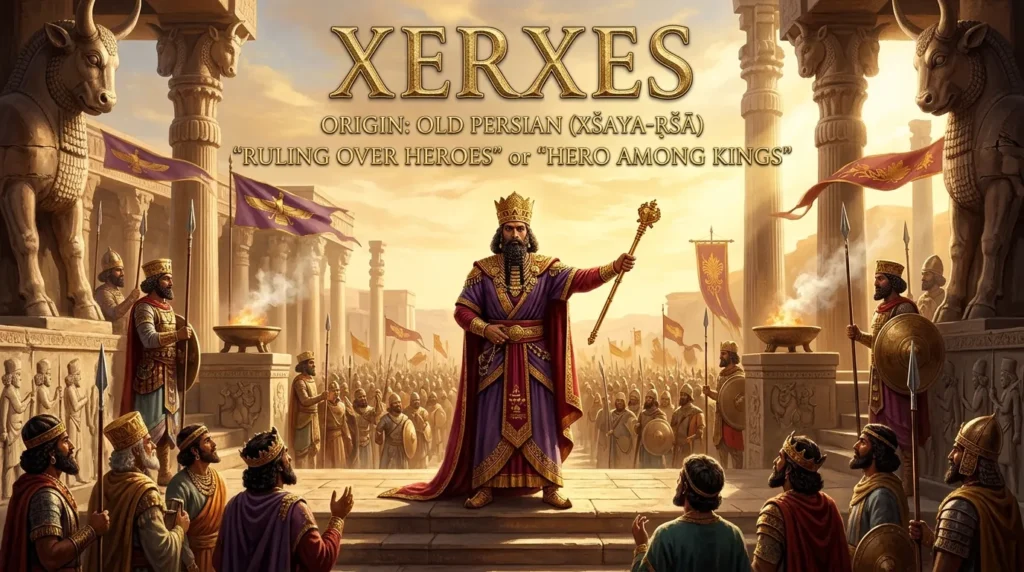

Have you ever come across the name Xerxes in a history book, the Bible, or a movie about ancient Persia? It is a rare name with a powerful past. It belonged to Persian kings who ruled one of the largest empires in the ancient world.
The Xerxes meaning is commonly given as “ruler over heroes” or “ruling over heroes.” The name has Old Persian roots and carries a strong link to power, leadership, and royal history.
But there is more to this name than its royal image. Its original form, language, pronunciation, and use in ancient texts all help explain its meaning.
In this guide, you will learn where Xerxes comes from, how to pronounce it, what it means in the Bible, and why it remains an interesting choice as a personal name today. You will also discover its history, spelling, and related names.
Quick Answer
Xerxes means “ruler over heroes” or “one who rules over heroes.” It comes from the Old Persian name Xšayaṛšā. The name is best known through Xerxes I, a Persian king who ruled the Achaemenid Empire from 486 to 465 BCE.
Xerxes Meaning and Definition
Xerxes is a masculine name of ancient Persian origin. It is the Greek form of an Old Persian royal name, Xšayaṛšā.
The name is often explained as “ruler over heroes.” Some sources give slightly different translations because ancient names can have complex word roots and changes across languages.
The name carries ideas of:
- Leadership: It is linked to the idea of ruling.
- Strength: Its traditional meaning connects it with heroes.
- Power: Persian kings made the name famous.
- Royal heritage: It has a long history in ancient Persia.
Xerxes is not a modern invented name. It has a deep historical background that makes it stand out among traditional boy names.
Origin of the Name Xerxes
Xerxes comes from Old Persian, an ancient language used by the Persian Empire. Its original form was Xšayarša (also written Xšayāršā).
The Greeks later changed this name into Xérxēs. This Greek form became the English name Xerxes.
According to the Encyclopaedia Iranica, the original name has two main parts:
- Xšaya: A word linked to ruling or having power.
- ṛšā: A word linked to a hero or man.
Together, these parts give the meaning “ruling over heroes.”
This is more than a simple translation. It shows how ancient Persian names could express power, rank, and social status.
The name also appears in different forms across ancient languages. These forms help historians trace how the name traveled between Persia, Greece, Babylon, and other regions.
The original Persian form is important because Xerxes is not the name’s first version. It is the form that became well known through Greek and later Western history.
How to Pronounce Xerxes
The name Xerxes may look difficult to read because its spelling is not common in modern English.
In American English, people usually pronounce it:
ZURK-seez
It has two syllables:
- ZURK: The first syllable carries the main stress.
- seez: The second syllable sounds like the word “sees.”
Say the first part clearly, then finish with the second part.
The pronunciation may vary a little by accent. However, the American pronunciation is easy to learn once you hear it.
One common mistake is to pronounce the first letter like the usual English “X” sound in words such as “box.” In Xerxes, the name begins with a Z sound.
Xerxes in Ancient Persian History
The name Xerxes is famous because of Xerxes I, one of the best-known kings of ancient Persia.
He was the son of Darius I, also called Darius the Great. Xerxes became king in 486 BCE and ruled until 465 BCE.
He belonged to the Achaemenid dynasty. This dynasty ruled a large empire that covered parts of Asia, the Middle East, and other regions.
Xerxes I is especially known for his campaign against Greece. In 480 BCE, he led a large Persian invasion of Greece.
His forces won some early victories, but the campaign did not achieve its main goal. The Persian navy suffered a major defeat at the Battle of Salamis.
This event became an important part of ancient Greek and Persian history.
Xerxes also appears in historical records and ancient accounts about royal life, government, and military campaigns.
His name became famous because of his position as a powerful king. This history also helped keep the name alive for many centuries.
It is worth remembering that the meaning of a name and the actions of its famous bearer are two different things. The meaning refers to its language roots, while the king’s history tells us about the person who carried it.
Is Xerxes a Biblical Name?
Yes, Xerxes has a connection to the Bible through the name Ahasuerus.
The name Ahasuerus appears in several Old Testament passages. One of the best-known examples is the Book of Esther.
In Esther, Ahasuerus is the king of Persia. He chooses Esther as queen, and she later plays an important role in protecting her people.
Many historians and biblical scholars identify this Ahasuerus with Xerxes I. The Hebrew form of the name is believed to represent the Old Persian name Xšayarša.
However, it is important to explain this connection with care. The identification is widely accepted, but some historical and biblical discussions have raised questions about the king’s identity.
The name Ahasuerus is also found in Ezra and Daniel. These passages do not all refer to the same historical person.
So, when someone asks whether Xerxes appears in the Bible, the clearest answer is that his name is connected to the biblical Ahasuerus, especially in the traditional identification of the king in Esther.
Does Xerxes have a biblical meaning?
No separate biblical meaning is established for the name. Its original meaning comes from Old Persian, not from Hebrew.
Its biblical importance comes from its possible connection to the Persian king in the Book of Esther.
What Does Xerxes Mean in the Bible?
The meaning of Xerxes does not change when people discuss its biblical connection.
Its Old Persian meaning remains “ruling over heroes.” The Bible uses the related name Ahasuerus rather than the Greek form Xerxes in the traditional English translation of Esther.
This difference comes from the way names changed as people moved between languages.
Here is a simple way to understand the connection:
- Old Persian: The original royal name was Xšayarša.
- Greek: The name became Xérxēs.
- Hebrew: A related form appeared as Ahasuerus.
- English: Readers often see Xerxes in history books and Ahasuerus in Bible translations.
This is why the same historical name can look different in different texts.
If you are reading Esther, look for Ahasuerus. If you are reading about ancient Persian kings, you will usually see Xerxes I.
The two names have a strong historical connection, but readers should not assume that every person called Ahasuerus in every ancient text must be Xerxes I. Context matters.
Encyclopaedia Iranica+2
Is Xerxes a Good Name for a Baby Boy?
Xerxes can be an interesting choice for parents who want a rare name with a strong historical background.
It has an ancient Persian origin and a meaning linked to leadership and heroes. It also has a clear connection to one of the most famous royal dynasties in history.
However, it is not a common everyday name in modern English-speaking countries. Some people may need help saying or spelling it.
Before choosing it, think about how it will sound with your family name. Also consider whether you like its historical image and cultural background.
Here are some reasons parents may like or dislike it.
| Advantages of Xerxes | Possible disadvantages |
| Has an ancient Persian origin | May be hard to pronounce at first |
| Carries a strong meaning | Not a familiar everyday name |
| Has royal historical roots | Some people may misspell it |
| Is short and distinctive | Has a strong historical association |
| Has a connection to ancient culture | May sound unusual to some families |
There is no single perfect name for every child. The best choice depends on personal taste, family history, and cultural meaning.
Xerxes Name Meaning, Gender, and Quick Facts
If you want a quick overview, the following table brings together the main facts about the name.
| Name detail | Information |
| Name | Xerxes |
| Meaning | Ruling over heroes |
| Origin | Old Persian |
| Original form | Xšayarša |
| Greek form | Xérxēs |
| Gender | Masculine |
| Name type | Historical royal name |
| Pronunciation | ZURK-seez |
| Biblical connection | Ahasuerus |
| Famous bearer | Xerxes I |
| Related language | Ancient Greek and Old Persian |
| Name theme | Leadership, power, and royalty |
These details make Xerxes a distinctive name with a strong link to ancient Persian culture.
Xerxes vs. Ahasuerus: What Is the Difference?
Xerxes and Ahasuerus are closely related names. Both connect to the Old Persian royal name Xšayarša.
However, they come from different language traditions.
Xerxes is the familiar Greek form. Ahasuerus is the form used in many English Bible translations.
This difference can confuse readers who study both ancient history and the Bible.
The following comparison makes the distinction easier to understand.
| Feature | Xerxes | Ahasuerus |
| Language form | Greek | Hebrew |
| Original connection | Old Persian Xšayarša | Old Persian Xšayarša |
| Common use | Ancient history | Biblical texts |
| Famous reference | Xerxes I | Book of Esther |
| Meaning | Ruling over heroes | Same Persian name origin |
| English usage | Historical name | Biblical name |
The main difference is not the meaning. It is the language and the way each name appears in historical and religious writing.
For example, a history book may discuss Xerxes I, while a Bible study may discuss King Ahasuerus in Esther.
Both forms help readers understand the cultural and historical influence of ancient Persia.
Other Forms and Related Names of Xerxes
Names often change as they move between languages. Xerxes is a good example of this process.
Its original Persian form and later versions appear in different historical records.
Here are some related forms:
- Xšayarša: The original Old Persian form.
- Khshayarsha: An alternative English rendering of the Persian form.
- Xérxēs: The Ancient Greek form.
- Ahasuerus: The biblical form found in English translations.
- Achašweroš: A form of the name in Hebrew.
These forms do not all have the same spelling or pronunciation. However, they help show the connection between ancient Persian history and later languages.
Is Xerxes Still Used as a Name Today?
Yes, Xerxes is still used as a personal name, although it is uncommon.
Many modern parents prefer names that are easy to spell and pronounce. Others enjoy choosing names with unusual sounds, ancient roots, and strong historical meanings.
Xerxes fits the second group.
It may appeal to people who enjoy Persian history, ancient civilizations, or names with royal connections.
The name also appears in popular culture and historical fiction. These references can make it familiar to some people, even if they have never met someone with the name.
However, its modern popularity should not be confused with its historical importance. Xerxes became famous thousands of years ago, long before modern baby-name trends existed.
Quick Reference: What to Know Before Using Xerxes
Keep these points in mind if you are researching or considering this name:
| What to check | Helpful information |
| Correct meaning | Ruling over heroes |
| Original spelling | Xšayarša |
| Name origin | Ancient Persian |
| Pronunciation | ZURK-seez |
| Biblical form | Ahasuerus |
| Historical figure | Xerxes I |
| Best-known quality | Strong royal history |
| Name style | Rare and traditional |
This quick guide can help you understand the name without confusing its original meaning with its historical or biblical use.
FAQs:
1. What does the name Xerxes mean?
Xerxes means “ruling over heroes” or “ruler over heroes.” It comes from the Old Persian name Xšayarša. The name combines an element linked to ruling with another linked to a hero or man. It is best known as the name of an ancient Persian king.
2. Is Xerxes a Persian name?
Yes. Xerxes has ancient Persian roots. Its original form was Xšayarša, but the familiar spelling Xerxes comes from Ancient Greek. The name became widely known through the Persian king Xerxes I, who ruled the Achaemenid Empire.
3. Is Xerxes mentioned in the Bible?
Xerxes is connected to the biblical name Ahasuerus. This king appears in the Book of Esther, where he rules Persia and chooses Esther as queen. Many scholars identify him with Xerxes I, although the historical identification has been discussed.
4. What is the Hebrew name for Xerxes?
Ahasuerus is the Hebrew name commonly linked to Xerxes. It appears in English translations of the Old Testament. The Hebrew form represents an adaptation of the Old Persian royal name Xšayarša.
5. How do you pronounce Xerxes?
In American English, Xerxes is usually pronounced ZURK-seez. It has two syllables, with the main stress on the first syllable. The first sound is like the letter Z, not the usual X sound in English words.
6. Was Xerxes a real Persian king?
Yes. Xerxes I was a real Persian king who ruled from 486 to 465 BCE. He was the son of Darius I and belonged to the Achaemenid dynasty. He is famous for leading a major Persian campaign against Greece in 480 BCE.
7. Is Xerxes a good name for a boy?
Xerxes can be a good choice for parents who like rare names with ancient roots. It has a strong historical background and a meaning linked to leadership. However, some people may find its spelling or pronunciation unfamiliar, so parents should consider this before choosing it.
Conclusion:
The Xerxes meaning is “ruling over heroes.” It comes from the ancient Persian name Xšayarša and has a long connection to royal history.
The name became famous through Xerxes I, a Persian king who ruled one of the largest empires of the ancient world. It also has a biblical connection through Ahasuerus in the Book of Esther.
If you are researching its history, studying its biblical connection, or considering it as a baby name, Xerxes is a name with a rich past. Understanding its origin and meaning helps you appreciate its true value.

Hey, I am passionate about exploring the meanings of English words and helping people understand language in a simple way. I enjoy researching word definitions, discovering different meanings, and explaining how words are used in everyday conversations. At Publarex.com, I focus on creating easy-to-understand explanations of words, slang, phrases, and expressions. I believe that knowing the meaning of a word is important for better communication and learning. My goal is to help readers find accurate information, expand their vocabulary, and understand English with confidence.