
Have you ever watched a boxer move quickly from side to side to avoid getting hit? Or heard someone say that a politician keeps dodging hard questions? In both cases, the phrase bob and weave can describe what is happening.
The bob and weave meaning is to move your body up and down and from side to side to avoid being hit or caught. It comes from boxing, where fighters use this movement to avoid their opponent’s punches. However, the phrase has another common meaning in everyday English.
It can describe someone who avoids direct questions, difficult talks, or responsibility.
People in the United States often use this idiom in sports, work, news, and casual talks. In this guide, you will learn its full meaning, boxing roots, common uses, synonyms, and simple examples. You will also see how to use it in your own sentences without making common mistakes.
Quick Answer: What Does Bob and Weave Mean?
Bob and weave means to move quickly up and down and from side to side to avoid being hit. It is a boxing move used to dodge punches. In everyday speech, it also means to avoid difficult questions, problems, or direct answers.
For example:
- Boxing: The fighter used a bob and weave move to avoid the punch.
- Daily conversation: The manager kept bobbing and weaving when workers asked about their pay.
Both examples show the idea of avoiding something rather than facing it directly.
Bob and Weave Definition and Meaning
The phrase has two main meanings. The first is physical, while the second is figurative.
1. Physical meaning
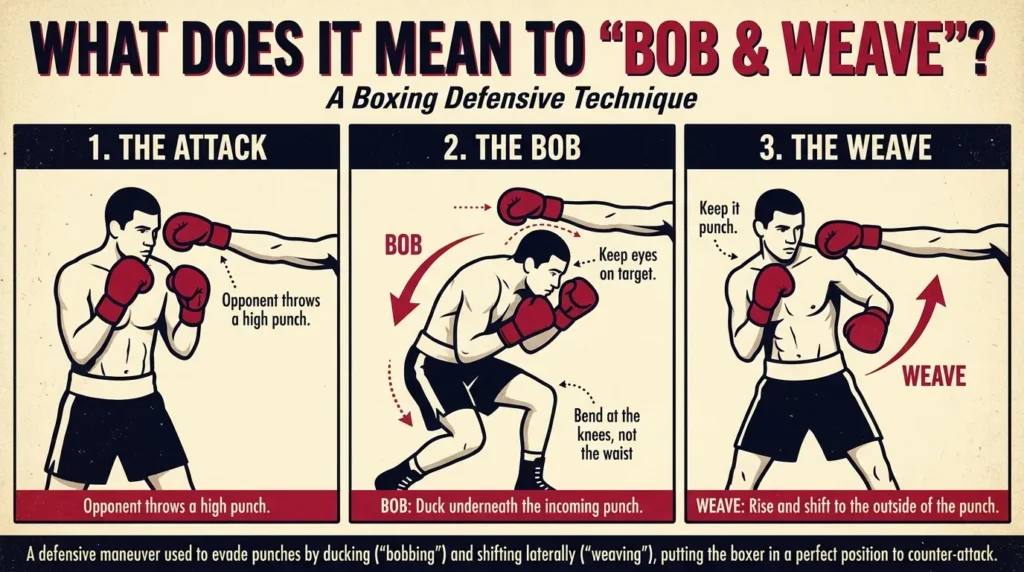
In boxing, bob and weave describes a defensive move. A fighter bends the knees, lowers the body, and moves from side to side. This helps the fighter avoid punches from an opponent.
The goal is simple: make it harder for the other fighter to land a clean hit.
You may see this move during boxing matches, kickboxing training, or other combat sports.
2. Figurative meaning
In everyday English, bob and weave means to avoid something without giving a clear answer or facing it directly.
A person may bob and weave when they:
- Avoid answering a direct question.
- Try to escape blame.
- Change the subject during a serious talk.
- Avoid making a clear choice.
- Find ways around a difficult situation.
For example:
“Whenever I ask him about the missing money, he starts to bob and weave.”
This means he avoids giving a clear answer about the money.
Where Does the Phrase Bob and Weave Come From?
The phrase comes from boxing. It describes two simple types of body movement.
- Bob: To move up and down with a quick, short movement.
- Weave: To move from side to side in a smooth way.
When a boxer puts these movements together, the fighter can move under and around incoming punches.
The phrase became part of everyday English because people began using boxing terms to describe normal life.
Think about someone who avoids every difficult question in a meeting. That person is not fighting in a ring, but they are still trying to dodge something.
The expression captures that behavior in a short and clear way.
The word “bob” has a long history in English. Etymonline records its use for an up-and-down movement and notes the boxing expression in its historical entry.
Bob and Weave Meaning in Boxing
In boxing, bob and weave is a defensive technique. A boxer uses the legs and body to move away from an incoming punch.
Instead of standing in one place, the fighter changes the position of the head and upper body.
Here is how the movement works:
1. Bend your knees
The boxer lowers the body by bending the knees. This helps the head move below an incoming punch.
2. Move from side to side
The boxer shifts the body to one side and then the other. This helps avoid punches that travel across the head.
3. Keep your eyes on the opponent
The boxer must watch the other fighter. Losing sight of an opponent can make the move less useful.
4. Return to a balanced position
After the movement, the boxer should stay ready to defend or respond.
The technique takes practice. It is not just about moving the head quickly. Good balance, timing, and control also matter.
Professional boxers have used this defensive style in many different ways. Joe Frazier is one well-known example of a fighter associated with bobbing and weaving.
Bob and Weave Meaning in Everyday Conversation
Outside boxing, the phrase often describes someone who avoids a direct answer.
Imagine that your boss asks a worker why a project is late. Instead of explaining the problem, the worker talks about the weather, another team, and an old meeting.
The worker is bobbing and weaving around the question.
This use often has a negative tone. It may suggest that someone is not being honest or does not want to face the truth.
Here are some common situations:
At work: An employee keeps avoiding questions about unfinished tasks.
In politics: A public figure avoids giving a clear answer during an interview.
In relationships: A partner changes the subject whenever money comes up.
During an argument: Someone avoids the main point instead of discussing it.
The phrase does not always mean that a person is lying. Sometimes, they may feel nervous or unsure. The exact meaning depends on the situation.
Bob and Weave Meaning in a Sentence: 10 Examples
The best way to understand an idiom is to see how people use it in real sentences.
Here are 10 original examples with simple explanations.
1. The boxer used his skills to bob and weave around every punch.
Meaning: The boxer moved to avoid getting hit.
2. Stop trying to bob and weave when I ask you a simple question.
Meaning: Stop avoiding my question and answer directly.
3. The politician continued to bob and weave during the interview.
Meaning: The politician avoided giving clear answers.
4. She had to bob and weave through the crowded room.
Meaning: She moved around people to get through the room.
5. My brother likes to bob and weave whenever we discuss his homework.
Meaning: He tries to avoid talking about his homework.
6. The fighter learned how to bob and weave during training.
Meaning: The fighter learned a defensive boxing move.
7. The company cannot keep bobbing and weaving around customer complaints.
Meaning: The company must stop avoiding customer problems.
8. He tried to bob and weave when his teacher asked about the broken chair.
Meaning: He avoided giving a direct answer.
9. Good boxers know when to bob and weave instead of taking every punch.
Meaning: Skilled boxers use body movement to avoid attacks.
10. The reporter noticed that the speaker was bobbing and weaving around the main issue.
Meaning: The speaker was avoiding the important topic.
These examples show that the phrase can describe both physical movement and a person’s behavior.
Bobbing and Weaving: What Does It Mean?
Bobbing and weaving is the continuous or repeated form of the same movement.
In boxing, it describes a fighter who keeps moving the body up and down and from side to side to avoid punches.
In everyday English, it can describe someone who keeps avoiding questions or difficult situations.
For example:
- “The boxer was bobbing and weaving throughout the match.”
- “She was bobbing and weaving when her parents asked about her grades.”
There is a small grammar difference between the two forms:
- Bob and weave: The basic phrase.
- Bobbing and weaving: The -ing form.
- Bobbed and weaved: The past-tense form.
All three can describe the same basic idea.
Bob and Weave vs. Duck and Weave
You may also hear the phrase “duck and weave.” Both expressions describe movements used to avoid something.
However, their use can depend on the speaker and the situation.
| Bob and weave | Duck and weave |
| Common in American English | Also used in English |
| Often linked with boxing | Also linked with avoiding danger |
| Means moving up and down and side to side | Highlights ducking and moving away |
| Can describe avoiding questions | Can also describe avoiding difficult situations |
Both phrases can have a figurative meaning.
For example:
- “He kept bobbing and weaving during the interview.”
- “She had to duck and weave around difficult questions.”
The main idea in both sentences is avoidance.
Cambridge Dictionary notes that “duck and weave” is the usual British English alternative to the American expression “bob and weave.”
Bob and Weave Synonyms and Similar Expressions
If you want to use other words instead of bob and weave, several options can work.
The best choice depends on whether you are talking about physical movement or avoiding a question.
Synonyms for physical movement:
- Dodge: Move quickly to avoid something.
- Duck: Lower your head or body to avoid a hit.
- Weave: Move from side to side.
- Sidestep: Move to one side to avoid something.
- Evade: Escape something by moving away.
Similar expressions for avoiding questions:
- Beat around the bush: Avoid saying something directly.
- Dodge the question: Avoid giving a clear answer.
- Change the subject: Start talking about something else.
- Evade responsibility: Avoid accepting blame.
- Give a vague answer: Reply without giving clear details.
These expressions are close in meaning, but they do not always fit the same sentence.
For example, “sidestep” works well for physical movement, while “beat around the bush” works better when someone avoids a direct answer.
Is Bob and Weave a Positive or Negative Phrase?
The phrase can have either a positive or negative meaning. It depends on how someone uses it.
In boxing, bobbing and weaving is often a useful defensive skill. It helps a fighter avoid punches and stay in the match.
In daily conversation, the phrase often has a negative meaning. It can suggest that someone is avoiding the truth or refusing to answer a fair question.
However, it can also describe smart movement through a difficult situation.
For example:
“The driver had to bob and weave through the narrow streets.”
This sentence does not suggest dishonesty. It simply describes careful movement.
Compare that with:
“The manager kept bobbing and weaving when the staff asked about their salaries.”
Here, the phrase suggests that the manager avoids a serious issue.
Always look at the full sentence to understand the speaker’s meaning.
Common Mistakes When Using Bob and Weave
Many English learners understand the basic meaning but still make small mistakes when using this idiom.
Here are some things to avoid.
1. Thinking it only relates to boxing
The phrase comes from boxing, but people also use it in daily conversations, news, and work settings.
2. Using it only for dishonest people
Someone who bobs and weaves may be avoiding a question, but that does not always prove they are lying.
3. Confusing it with weaving fabric
The word “weave” can refer to making cloth by joining threads. However, in this idiom, it means moving from side to side.
4. Forgetting the past-tense form
The correct past-tense form is “bobbed and weaved.”
Example: “He bobbed and weaved to avoid the punch.”
5. Using it in every situation involving movement
The phrase works best when the movement involves avoiding something. It is not a general word for walking or running.
Quick Reference: How to Use Bob and Weave Correctly
Use this table to choose the right form and meaning.
| Situation | Correct expression | Example |
| Boxing movement | Bob and weave | He can bob and weave well. |
| Repeated movement | Bobbing and weaving | She was bobbing and weaving. |
| Past action | Bobbed and weaved | He bobbed and weaved in the ring. |
| Avoiding a question | Bob and weave | Stop trying to bob and weave. |
| Avoiding a problem | Bobbing and weaving | They keep bobbing and weaving. |
| Moving through a crowd | Bob and weave | He had to bob and weave through people. |
A simple tip: If someone moves to avoid a punch, the phrase has a physical meaning. If someone avoids a direct answer, it has a figurative meaning.
FAQs:
1. What does bob and weave mean in simple words?
Bob and weave means moving up and down and from side to side to avoid being hit. In everyday conversation, it means avoiding questions, problems, or direct answers. The phrase comes from boxing but has become common in American English.
2. What does bob and weave mean in slang?
In informal speech, bob and weave often means avoiding a difficult question or situation. Someone who keeps changing the subject instead of giving a clear answer may be described as bobbing and weaving. It is an informal expression, not a separate slang abbreviation.
3. What does it mean when someone is bobbing and weaving?
It means the person is repeatedly moving to avoid something. In boxing, they avoid punches. In a conversation, they may avoid questions or refuse to discuss an issue directly.
4. Is bob and weave a boxing term?
Yes. Bob and weave is a boxing term for a defensive movement. A fighter bends the knees and moves the body from side to side to avoid incoming punches. People also use the phrase outside sports to describe avoidance.
5. What is another word for bob and weave?
Some similar words include dodge, duck, sidestep, and evade. For avoiding questions, you can use phrases such as “beat around the bush” or “dodge the question.” Choose the expression that best fits the situation.
6. Is bob and weave positive or negative?
It can be both. In boxing, it describes a useful defensive skill. In a conversation, it often suggests that someone is avoiding an important question. The tone depends on the context and the speaker’s purpose.
7. What is the difference between bob and weave and duck and weave?
Both phrases describe movements used to avoid something. Bob and weave is common in American English, while duck and weave is often used as an alternative, especially in British English. Both can also describe avoiding difficult questions or situations.
Conclusion:
The bob and weave meaning is simple: move up and down and from side to side to avoid being hit. The phrase comes from boxing, where fighters use this movement to avoid punches. In everyday English, it also describes someone who avoids questions, problems, or direct answers.
You can use this idiom in sports, work, news, and casual conversations. Remember that its meaning depends on the context.
When you hear someone say that a person is bobbing and weaving, look at what they are trying to avoid. That small detail will help you understand the phrase correctly and use it with confidence.

Hey, I am passionate about exploring the meanings of English words and helping people understand language in a simple way. I enjoy researching word definitions, discovering different meanings, and explaining how words are used in everyday conversations. At Publarex.com, I focus on creating easy-to-understand explanations of words, slang, phrases, and expressions. I believe that knowing the meaning of a word is important for better communication and learning. My goal is to help readers find accurate information, expand their vocabulary, and understand English with confidence.