
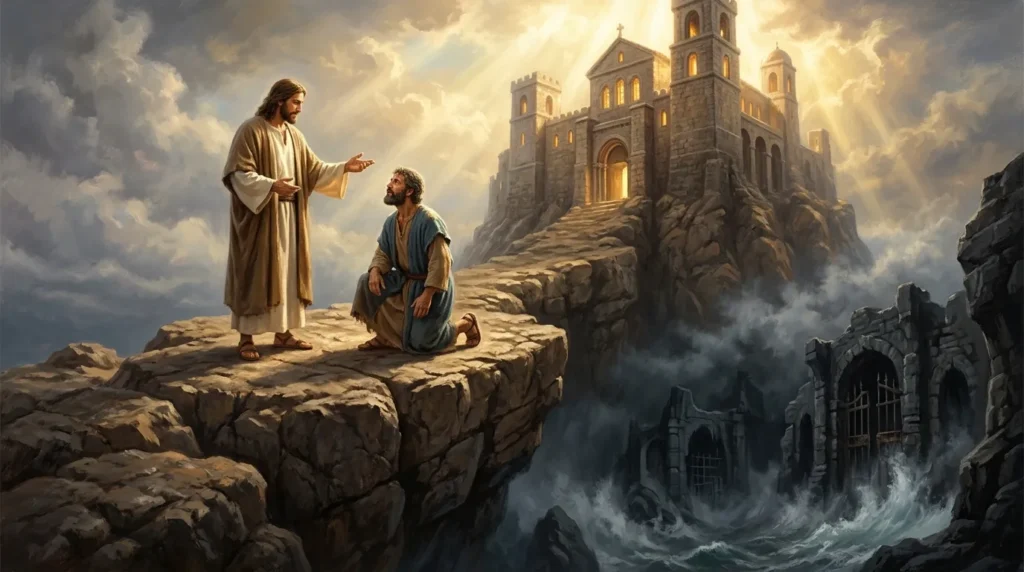

Matthew 16:18 is one of the most discussed verses in the Bible. Jesus speaks to Peter and says that He will build His church upon a rock. He also promises that the gates of Hades will not overcome it.
But what did Jesus mean by calling Peter a rock? Was He saying that Peter would lead the church? Was He talking about Peter’s faith in Him? Or was He pointing to Himself as the true foundation of the church?
The Matthew 16:18 meaning becomes clearer when we read the words around it. Jesus had just asked His disciples who they believed He was. Peter answered that Jesus was the Messiah, the Son of the living God.
This moment helps us understand the meaning of the rock, the church, and Jesus’ promise. In this guide, we will explore the verse in simple words, look at its biblical context, and learn how Christians can apply its message to their lives today.
Quick Answer: What Does Matthew 16:18 Mean?
Matthew 16:18 means that Jesus would build His church on a strong foundation connected to Peter’s confession of faith in Him as the Messiah.
Jesus promised that the powers of death and evil would not destroy His church. The verse shows His authority, His plan for His followers, and His promise to keep His church.
Matthew 16:18 Definition and Meaning
Matthew 16:18 is a Bible verse in the Gospel of Matthew. In this verse, Jesus tells Peter that he is a rock and that He will build His church upon it.
The verse has three main ideas:
- The rock: A picture of a firm foundation. Christians discuss whether it points to Peter, his confession of faith, or both.
- The church: The community of people who believe in and follow Jesus.
- The gates of Hades: A picture of the power of death, which will not defeat Christ’s church.
The main message is that Jesus is the builder and owner of His church. He gives His followers a lasting mission and promises that death will not have the final victory over them.
1. The Biblical Context of Matthew 16:18
To understand this verse, we must first look at what happened before Jesus spoke these words.
In Matthew 16:13–20, Jesus and His disciples went to the region of Caesarea Philippi. There, He asked them an important question:
Who do people say that the Son of Man is?
The disciples shared different answers. Some people thought Jesus was John the Baptist. Others thought He was Elijah, Jeremiah, or another prophet.
Then Jesus asked a more personal question:
Who do you say I am?
Peter answered with faith:
“You are the Christ, the Son of the living God.” (Matthew 16:16)
Jesus praised Peter for this answer. He explained that Peter had not learned this truth from human wisdom. His Father in heaven had revealed it to him.
Then Jesus spoke the words found in Matthew 16:18.
This order matters. Peter first declared who Jesus was. Then Jesus spoke about the rock and His church.
It shows that the church would not rest on human power, wealth, or fame. Its foundation would be linked to the truth about Jesus Christ.
A helpful lesson: Faith begins when we know who Jesus is, not just when we know stories about Him.
2. What Does “You Are Peter” Mean?
The words “You are Peter” have a special meaning.
Before this moment, Peter was known as Simon. Jesus had given him the name Peter, which means rock.
In the Greek text, the name Peter is Petros, while the word translated as rock is petra.
These words form a play on words. Jesus connects Peter’s name with the rock on which He will build His church.
The connection becomes even clearer when we look at the Aramaic language. The word Kepha means rock. Peter was also known as Cephas, a name used in several New Testament passages.
For example, John 1:42 connects Simon with the name Cephas, which is translated as Peter.
This language detail helps explain why many Bible scholars understand Peter as the rock in this verse. However, Christians still discuss how Peter’s role relates to his confession of faith and to Jesus Himself.
USCCB+2
The important point is that Peter did not become the foundation through his own strength. His role came from Jesus and the truth he had confessed.
3. Who Is the Rock in Matthew 16:18?
This is one of the most common questions about Matthew 16:18.
Christians have different views about the identity of the rock. Three main interpretations help explain the discussion.
Peter Is the Rock
The first view is that Jesus was speaking directly about Peter.
The words “You are Peter, and upon this rock” create a clear link between Peter’s name and the foundation of the church.
Supporters of this view believe Jesus gave Peter a special role among the apostles. Peter would help lead the early church and share the message of Christ.
They also point to Matthew 16:19, where Jesus gives Peter the keys to the kingdom of heaven.
Peter’s Confession Is the Rock
The second view focuses on what Peter said before Jesus spoke about the rock.
Peter declared that Jesus was the Messiah and the Son of the living God.
According to this view, the rock represents this confession of faith. The church stands on the truth that Jesus is God’s Son and the promised Messiah.
Without this truth, the church would lose its central message.
Jesus Christ Is the Ultimate Foundation
The third view focuses on Jesus as the true foundation of the church.
Other Bible passages support this idea.
For example, 1 Corinthians 3:11 says that no one can lay another foundation besides Jesus Christ.
Ephesians 2:20 also describes the church as built on the foundation of the apostles and prophets, with Christ Jesus as the cornerstone.
This shows that Jesus holds the highest place in the church.
How Can We Understand These Views Together?
These views do not always have to compete with one another.
Peter can have a special role as the person who confesses Jesus. His confession points to Christ, and Christ remains the ultimate source and foundation of the church.
The verse itself does not give a full explanation of every later church structure. It does, however, clearly show that Jesus chose Peter for an important role in His plan.
Bible Gateway+2
4. What Does “I Will Build My Church” Mean?
Jesus also makes an important promise in this verse:
“I will build my church.”
These words show that the church belongs to Jesus. He does not say that Peter will build it. He says that He will build it.
The Greek word for church is ekklesia. In this setting, it refers to the community of people gathered under Christ.
It is not limited to a building made of stone, wood, or brick.
A church building can provide a place for worship. But the church itself is made up of people who follow Jesus, trust His teaching, and share His message.
This gives us three important lessons.
First, Jesus is the builder. The church does not depend only on human plans or leadership.
Second, Jesus is the owner. No person can claim that the church belongs to them.
Third, believers share a mission. They are called to live by His teaching and spread the good news.
Matthew 16:18 also reminds us that the church is part of God’s plan. Jesus did not create a group with no purpose. He gathered people to follow Him and share His message with the world.
5. What Does “The Gates of Hades Will Not Prevail” Mean?
This is another key part of the verse.
Some Bible translations use the word “hell,” while others use “Hades” or “the realm of the dead.”
The Greek word is Hades. It refers to the realm of the dead.
In the ancient world, people often pictured a city with strong gates. These gates stood for power, safety, and control.
Jesus uses this image to make a strong promise.
The power of death will not defeat His church.
This does not mean that Christians will never face pain, danger, loss, or persecution. The Bible records many examples of believers who suffered for their faith.
Instead, Jesus promises that death and evil will not have the final victory over His church.
His promise points to the lasting power of God’s work.
Does This Mean Christians Will Never Die?
No. This verse does not promise that every believer will live forever on earth.
Christians still face death. Peter himself later died because of his faith, according to early Christian tradition.
The promise is about the final victory of Christ and the lasting life of His church.
Jesus’ resurrection gives this promise even greater meaning. Death could not hold Him, and His followers trust in the same hope of resurrection.
The main lesson is simple: the church may face hard times, but death cannot cancel God’s plan.
Bible Gateway+2
6. How Does Matthew 16:19 Connect to Matthew 16:18?
We cannot fully understand the meaning of Matthew 16:18 without looking at the next verse.
In Matthew 16:19, Jesus tells Peter that He will give him the keys to the kingdom of heaven.
He also speaks about binding and loosing.
These images describe authority and responsibility.
What Do the Keys to the Kingdom Mean?
In the Bible, keys can represent the right to open and close something.
A helpful Old Testament connection appears in Isaiah 22:22. There, the key of the house of David represents authority given to a royal official.
In Matthew 16:19, Jesus uses the image of keys to show that Peter receives an important responsibility in the kingdom of heaven.
Peter would help open the way for people to hear and respond to the gospel.
We can see his public role later in Acts 2, when he speaks to a crowd about Jesus after the Holy Spirit comes.
What Does Binding and Loosing Mean?
The words binding and loosing were used in Jewish teaching to discuss matters of authority and religious decisions.
In this passage, they point to the responsibility of teaching, guiding, and making decisions in line with God’s will.
Jesus does not give Peter permission to act against God’s truth. His authority must serve the kingdom.
Matthew 18:18 also uses the language of binding and loosing when Jesus speaks to His disciples as a group.
This shows that the work of guiding the church is not simply about personal power. It is about serving Christ and His people.
USCCB+1
7. Why Did Jesus Choose Peter?
Peter was not a perfect man.
He sometimes spoke before thinking. He made mistakes and struggled to understand Jesus’ mission.
Later in Matthew 26:69–75, Peter denied knowing Jesus three times.
This may seem surprising. How could someone who failed so badly have such an important role in the early church?
The answer is that Jesus saw more than Peter’s mistakes.
Peter had faith in Christ, even though his faith still needed to grow. Jesus knew his weaknesses and still gave him an important responsibility.
After His resurrection, Jesus restored Peter and called him to care for His followers (John 21:15–17).
This teaches us something important about God’s grace.
God does not call people because they are perfect. He can work through people who are willing to trust Him, learn, and grow.
Peter’s story reminds us that a mistake does not have to be the end of our faith journey.
8. Catholic and Protestant Views of Matthew 16:18
Matthew 16:18 has an important place in Christian discussions about church authority.
Catholic and Protestant Christians agree that Jesus is central to the church. However, they do not always agree about the full meaning of Peter’s role.
| Catholic view | Common Protestant views |
| Peter is the rock and receives a special role among the apostles. | Peter, his confession, or both may be understood as the rock. |
| The keys point to a special authority given to Peter. | The keys point to authority to serve, teach, and share the gospel. |
| Peter’s role has a lasting connection to the leadership of the church through the papacy. | Many Protestants do not accept that this verse establishes the authority of later popes. |
| The church has a visible structure and a continuing teaching office. | Church structures and views of authority differ across Protestant groups. |
The Catholic Understanding
The Catholic Church understands Peter as the rock chosen by Jesus.
It sees Matthew 16:18–19 as an important foundation for the special role of Peter and the office of the pope.
Catholic teaching connects Peter’s authority with the leadership of the church throughout history.
The Protestant Understanding
Many Protestant Christians understand Peter as the rock because of his faith and confession about Jesus.
Others place more emphasis on the confession itself or on Christ as the ultimate foundation.
Many Protestant groups also believe that church authority must remain under the authority of Scripture.
What Do Both Views Teach?
Both traditions recognize the importance of Peter’s confession.
They also agree that Jesus is the head of the church and that His followers must build their faith on Him.
It is helpful to understand these differences with respect rather than turning them into arguments.
bible.org+2
9. Mistakes People Make When Reading Matthew 16:18
Some readers focus on one part of the verse and miss its wider message.
Here are a few common mistakes and a better way to understand them.
| Common mistake | Better understanding |
| Peter was perfect and never failed. | Peter had weaknesses, but Jesus still gave him an important role. |
| The church means only a physical building. | The church refers to the community of Christ’s followers. |
| Christians will never face suffering. | Jesus promises lasting victory, not a life without pain. |
| Hades means that Satan can never attack believers. | The verse promises that the power of death will not defeat Christ’s church. |
| The rock has only one interpretation accepted by all Christians. | Christians differ on the exact meaning of the rock. |
| Peter built the church by his own power. | Jesus clearly says that He will build His church. |
The best way to read this verse is to consider its full setting, the words Jesus used, and the message of the rest of Scripture.
10. What Does Matthew 16:18 Teach Us Today?
Matthew 16:18 is not only about Peter and the early church. It also gives Christians lessons they can use in daily life.
Here are five practical lessons.
1. Build Your Faith on Jesus
A strong faith starts with knowing Jesus.
Peter’s confession reminds us that Jesus is the Messiah and the Son of God.
When life becomes hard, return to His words and trust His promises.
2. Do Not Give Up During Hard Times
Jesus never said that His followers would have an easy life.
However, He promised that the power of death would not defeat His church.
This gives believers hope when they face fear, loss, or trouble.
3. Serve Others With Humility
Peter received an important role, but that role was a call to serve.
Christian leadership should not be about pride or control. It should be about helping others grow in faith.
4. Stay Connected to Other Believers
Jesus spoke about building a church, not just creating separate followers with no connection to one another.
Christians can support each other through prayer, worship, love, and service.
5. Remember That Jesus Is in Control
Church leaders may change. Buildings may close. People may disagree.
But Jesus remains the builder of His church.
This truth helps believers keep their focus on Him rather than on human power.
Quick Reference: How to Apply Matthew 16:18
Use these points to put the message of this verse into practice:
- Put your trust in Jesus Christ.
- Learn what the Bible teaches about Him.
- Stay strong when life becomes difficult.
- Support other believers through love and prayer.
- Serve others with humility.
- Remember that Jesus is the head of the church.
- Keep your hope in God’s promise of victory over death.
11. Other Bible Verses Related to Matthew 16:18
Several Bible passages help us understand the message of Matthew 16:18.
1. Matthew 7:24–25 : Building on the Rock
Jesus compares a wise person to someone who builds a house on rock. The house stands firm when storms come. This passage teaches us to build our lives on His words.
2. John 1:42 : Peter’s New Name
Jesus gives Simon the name Cephas, which means Peter. This helps explain the connection between Peter’s name and the rock in Matthew 16:18.
3. 1 Corinthians 3:11 : Jesus as the Foundation
Paul teaches that no one can lay another foundation besides Jesus Christ. This shows the central place of Christ in the faith.
4. Ephesians 2:20 : The Church’s Foundation
Paul describes the church as built on the foundation of the apostles and prophets, with Jesus Christ as the cornerstone.
5. John 21:15–17 : Jesus Restores Peter
After His resurrection, Jesus tells Peter to care for His sheep. This shows Peter’s responsibility to serve and guide other believers.
6. Acts 2:14–41 : Peter Preaches to the Crowd
Peter stands before a crowd and shares the message of Jesus. Many people respond to his words and receive baptism.
These passages help us see how Jesus’ promise in Matthew 16:18 connects with the wider story of the Bible.
FAQs:
1. What does Matthew 16:18 mean in simple words?
Matthew 16:18 means that Jesus will build His church on a strong foundation connected to Peter and his faith in Christ. He promises that the power of death will never defeat His church. The verse shows that Jesus is the builder, leader, and protector of His people.
2. Is Peter the rock in Matthew 16:18?
Many Christians and Bible scholars understand Peter as the rock because Jesus connects his name with the word rock. Others believe the rock points to Peter’s confession that Jesus is the Messiah. Some also stress that Jesus Himself is the ultimate foundation of the church.
3. What does the rock symbolize in Matthew 16:18?
The rock symbolizes a firm foundation for the church. It is closely linked to Peter’s confession that Jesus is the Son of the living God. It also reminds Christians that their faith must rest on the truth about Jesus rather than human strength.
4. What does the gates of Hades mean in Matthew 16:18?
The gates of Hades represent the power of death and the realm of the dead. Jesus promises that these powers will not overcome His church. This does not mean Christians will never suffer or die. It means death will not have the final victory over Christ and His people.
5. What is the meaning of the keys in Matthew 16:19?
The keys represent authority and responsibility in the kingdom of heaven. Jesus gives Peter an important role in guiding the early church and sharing the gospel. The keys also connect with the ideas of binding and loosing, which involve teaching and making decisions.
6. Does Matthew 16:18 prove that Peter was the first pope?
Catholic teaching understands this verse as an important foundation for Peter’s special authority and the later papacy. Many Protestant Christians disagree that the verse establishes the authority of later popes. They understand Peter’s role in different ways. The verse itself does not describe the full later structure of the papacy.
7. What can Christians learn from Matthew 16:18 today?
Christians can learn to trust Jesus, stay strong during hard times, and serve others with humility. The verse also reminds believers that the church belongs to Christ. Their hope should rest on His promises, not on human power or worldly success.
Conclusion:
The meaning of Matthew 16:18 reminds us that Jesus is the builder of His church. Peter received an important role because he confessed that Jesus was the Messiah and the Son of the living God. The rock, the church, and the gates of Hades all point to the lasting power of God’s plan.
This verse also teaches us to build our faith on Jesus, remain strong during hard times, and serve others with love and humility. Read Matthew 16:18–19 together to understand the full message. Keep studying the Bible, and let its truth guide your daily life.

I am Peter Sokolowski a passionate about English vocabulary, word meanings, and the fascinating ways language evolves over time. I enjoy exploring definitions, researching word histories, and explaining how different words are used in everyday communication. Through my work at Publarex.com, I aim to make English easier for readers by providing clear definitions, simple explanations, and practical examples. I believe every word has a story, and understanding its meaning can help people communicate more effectively.