
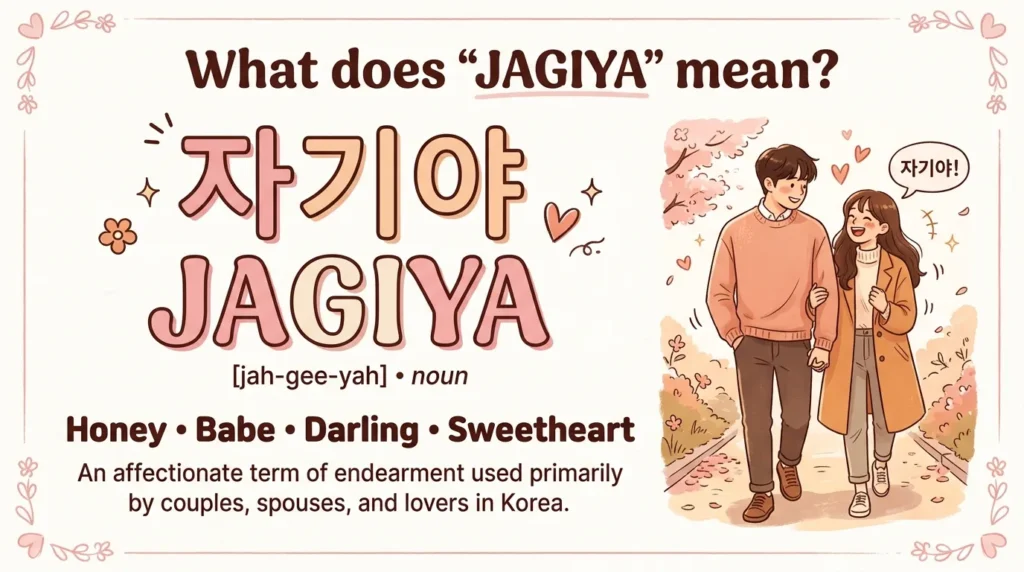

If you watch Korean dramas or listen to Korean couples talk, you may have heard the word jagiya. It often comes up in sweet moments between two people. You may hear it during a phone call, a text message, or a romantic scene.
But what does jagiya mean in Korean? Is it the same as saying “baby,” “honey,” or “darling” in English?
Jagiya (자기야) is a Korean term of affection that means “honey,” “darling,” “sweetheart,” or “baby.” Couples use it to address each other in a loving way. It can sound warm, playful, and romantic, depending on the speaker and the situation.
In this guide, you will learn its exact meaning, Korean spelling, pronunciation, and common uses. You will also see real-life examples, similar Korean words, and mistakes to avoid. This will help you understand the word when you hear it in Korean dramas or use it in a conversation.
Quick Answer
- Korean word: 자기야
- Romanization: Jagiya
- Meaning: Honey, darling, sweetheart, or baby
- Language: Korean
- Word type: Term of affection and direct address
- Common use: Romantic relationships
- Tone: Sweet, warm, and informal
Definition & Meaning of Jagiya in Korean
The Korean word 자기야 (jagiya) is a loving way to call someone you feel close to. It usually refers to a boyfriend, girlfriend, husband, or wife.
In English, the closest translations include:
- Honey
- Baby
- Babe
- Darling
- Sweetheart
- Dear
The best English translation depends on the situation. For example, one couple may use “baby,” while another may prefer “honey.” Both can express the same feeling as 자기야.
What Does Jagiya Mean Literally?
To understand this word, it helps to look at its two parts.
- 자기 (jagi): This word can mean oneself or the self. In romantic speech, it can also mean honey or darling.
- 야 (ya): This is a casual Korean calling ending. People use it when calling someone by name or using a familiar form of address.
Together, 자기야 becomes a warm way to call a loved one.
One important detail: 자기 does not always mean honey. Korean speakers also use it as a reflexive word meaning oneself. The sentence and situation help you understand which meaning applies.
How Do You Pronounce Jagiya?
The word 자기야 has three Korean syllable blocks:
- 자 (ja)
- 기 (gi)
- 야 (ya)
Its standard romanized form is jagiya.
When you say it, keep the three syllables smooth and even. Do not put a strong English-style stress on one part. The Korean sounds may feel a little different from their English letter names.
Here is a simple way to practice:
- Say the first syllable clearly.
- Move smoothly into the second syllable.
- Finish with a light final syllable.
- Repeat the whole word without a long pause.
The best way to learn the sound is to listen to a native Korean speaker and repeat it. Korean romanization can guide you, but it cannot show every detail of the original sound.
When Do Koreans Use Jagiya?
Koreans mainly use 자기야 in romantic relationships. It is a casual and personal word, so it works best when two people feel close.
1. Between Boyfriends and Girlfriends
Dating couples often use 자기야 as a sweet nickname. Both men and women can say it.
For example, a girlfriend may call her boyfriend 자기야 when she wants his attention. He can use the same word when speaking to her.
It does not belong to one gender. The relationship matters more than the speaker’s gender.
2. Between Married Couples
Partners may also use 자기야 in daily life. They might say it while cooking, shopping, talking on the phone, or sending a text.
Some married couples use 자기야 for many years. Others prefer different words, such as 여보 (yeobo).
3. In Text Messages
You may see 자기야 in Korean chats and social media messages. It can make a short message feel more loving.
For example:
자기야, 뭐 해?
Meaning: Honey, what are you doing?
The word can also appear with playful punctuation or repeated vowels in casual messages. These changes often show the writer’s tone rather than a new dictionary meaning.
4. In Korean Dramas and Movies
Korean dramas often use 자기야 in romantic scenes. A character may say it while meeting a partner, making a phone call, or sharing a private moment.
This is one reason many Korean learners recognize the word before they study its grammar.
However, remember that a drama does not show every part of daily Korean speech. Actors may use extra-sweet expressions to make a scene feel more romantic.
Is Jagiya Used for Both Men and Women?
Yes. 자기야 is a gender-neutral term of affection.
A man can call his girlfriend 자기야. A woman can call her boyfriend 자기야. Married partners can use it with each other too.
You do not need a different word based on whether your partner is male or female.
This makes it easier to learn than some Korean relationship terms. For example, 오빠 (oppa) has a different relationship and age-based use. It is not simply another version of 자기야.
The main thing to remember is that 자기야 is an intimate form of address. Use it when the other person is comfortable with that level of closeness.
Jagiya vs. Jagi: What Is the Difference?
These two forms look almost the same, but they do not always work in the same way.
자기 (jagi) is the shorter form. Between romantic partners, it can work like “honey” or “you.”
자기야 (jagiya) is commonly used when calling the partner directly. It sounds like calling out “Honey!” or “Babe!”
For example:
- 자기, 오늘 바빠? — Honey, are you busy today?
- 자기야! 여기 봐! — Babe! Look here!
The exact use can change with sentence structure. 자기 can also mean oneself, so do not translate every use as a romantic nickname.
Jagiya vs. Yeobo: What Is the Difference?
Both 자기야 and 여보 (yeobo) can mean “honey” or “darling.” However, they have different social uses.
자기야 is common among dating couples and married couples. It often feels like “babe” or “sweetheart.”
여보 is strongly linked to married couples. It is a familiar way for spouses to address each other.
Here is a simple comparison:
| Korean word | English meaning | Common use |
| 자기야 (jagiya) | Babe, honey, darling | Dating and married couples |
| 자기 (jagi) | Honey, you | Romantic partners |
| 여보 (yeobo) | Honey, dear | Mainly married couples |
| 애기야 (aegiya) | Baby | Affectionate or cute address |
| 내 사랑 (nae sarang) | My love | Romantic expression |
Neither word is better than the other. Couples choose the expression that feels natural to them. You may also hear married couples continue to use 자기야 after marriage.
Bori+2
10 Common Korean Sentences Using Jagiya
Learning a word becomes easier when you see it in real sentences. Here are ten simple examples to help you understand how Koreans may use 자기야.
| Korean sentence | English meaning |
| 자기야, 뭐 해? | Honey, what are you doing? |
| 자기야, 보고 싶어. | Babe, I miss you. |
| 자기야, 사랑해. | Honey, I love you. |
| 자기야, 어디야? | Darling, where are you? |
| 자기야, 밥 먹었어? | Honey, have you eaten? |
| 자기야, 전화해 줘. | Babe, call me. |
| 자기야, 기다려 줘. | Darling, please wait for me. |
| 자기야, 괜찮아? | Honey, are you okay? |
| 자기야, 같이 가자. | Babe, let’s go together. |
| 자기야, 고마워. | Honey, thank you. |
These examples use casual Korean. They fit conversations between people who already have a close relationship.
If you are learning Korean, focus on the whole sentence rather than memorizing 자기야 alone. The words around it help you understand the speaker’s feelings and purpose.
Can You Call Your Friends Jagiya?
Usually, you should not use 자기야 as a normal nickname for friends.
It has a strong romantic feel in many everyday situations. If you call a new friend 자기야, that person may think you are flirting or joking.
There are exceptions. Some close friends may use affectionate words playfully. Some women may also use 자기 or similar expressions with close female friends. However, this depends on the people and their social habits.
For a safe choice, use a friend’s name or an appropriate casual form of address.
You should also avoid using 자기야 with:
- People you have just met
- Teachers
- Your boss
- Customers
- Older people you do not know well
- People who prefer formal speech
The word is not rude by itself. The problem is using an intimate expression with someone who does not share that level of closeness.
Common Mistakes to Avoid When Using Jagiya
Korean words can have different meanings based on the person, tone, and situation. Keep these common mistakes in mind.
1. Using It With Everyone
Do not treat 자기야 like a normal greeting. It is an intimate word, not a general way to say hello.
2. Confusing Jagi With Jagiya
Both forms can express affection, but 자기야 works as a direct call to someone. 자기 can also have a non-romantic meaning.
3. Thinking It Is Only for Women
Men and women can both use 자기야. It is not a female-only nickname.
4. Thinking It Always Means Baby
Baby is one possible translation, but honey, darling, and sweetheart may fit better in some situations.
5. Confusing It With Yeobo
Both words express affection, but 여보 is more closely linked to married couples. 자기야 is also common among dating partners.
Jagiya: Quick Reference for Korean Learners
Use this checklist when you want to understand or use the word correctly.
| What to check | Simple guidance |
| Korean spelling | 자기야 |
| Romanization | Jagiya |
| Main meaning | Honey, babe, or darling |
| Relationship | Close romantic partner |
| Gender | Men and women can use it |
| Speech style | Casual and intimate |
| Best setting | Private talks and loving messages |
| Avoid using it with | Strangers, coworkers, and formal contacts |
Before using 자기야, keep these points in mind:
- Make sure the other person feels comfortable with pet names.
- Use it in a close and casual relationship.
- Learn the full sentence, not just the nickname.
- Listen to native Korean speakers to understand the tone.
- Choose a different form of address when the situation calls for polite speech.
Other Korean Terms of Endearment You Should Know
Korean has several loving words that people use with partners and family members. Learning these words will help you understand more conversations in Korean dramas and everyday life.
1. Yeobo (여보)
Yeobo means “honey” or “dear.” Married couples commonly use it when talking to each other.
It can sound warm and familiar. It is a good word to learn if you want to understand how Korean spouses address each other.
2. Aegi (애기)
Aegi means “baby” or “little child.” Some couples also use it as a cute nickname for their partner.
Its use depends on the relationship. It can sound playful and affectionate.
3. Oppa (오빠)
Oppa literally means an older brother when a woman uses it for an older male. Women may also use it to address an older boyfriend.
It is not a direct translation of honey. Age and relationship affect how people use it.
4. Nae Sarang (내 사랑)
Nae sarang means “my love.” It is a more direct expression of romantic affection.
You may hear it in love messages, songs, and emotional conversations.
5. Jagi (자기)
Jagi can mean “oneself.” Between romantic partners, it can also mean honey or darling.
It is the shorter form that you will often hear in sentences where a partner speaks directly to the other person.
These words are not perfect substitutes for one another. Each has its own tone and social use.
Why Is Jagiya So Popular in Korean Dramas?
Many Korean dramas show couples using affectionate words during romantic scenes. 자기야 is one of the expressions that viewers may notice.
There are a few reasons it stands out:
- It sounds personal: It shows that the speakers share a close bond.
- It fits daily conversations: Couples can use it while talking about simple things.
- It adds warmth: A short nickname can make an ordinary sentence feel more loving.
- It works for both partners: Either person can use it.
However, drama dialogue often makes emotions more dramatic than everyday speech. Not every Korean couple uses the same nickname. Some prefer names, other pet names, or no special nickname at all.
If you hear 자기야 in a drama, pay attention to who says it and how the other person responds. This can help you understand the relationship.
How to Use Jagiya Naturally in a Korean Conversation
If you are learning Korean, start with short and simple sentences. Do not try to use the word in every conversation.
Here is a simple practice method:
Step 1: Learn the spelling.
Remember that the Korean spelling is 자기야. Seeing the Hangul form will help you recognize it in subtitles and messages.
Step 2: Learn its main meaning.
Connect it with words such as honey, babe, and darling. Do not assume that one English word always gives the exact meaning.
Step 3: Practice short sentences.
Start with expressions such as 자기야, 뭐 해? (Honey, what are you doing?) and 자기야, 사랑해 (Honey, I love you).
Step 4: Understand the relationship.
Use it only when a close relationship makes the word suitable. Do not use it just because you heard it in a drama.
Step 5: Listen and repeat.
Listen to natural Korean conversations. Pay attention to the rhythm and tone instead of copying an exaggerated drama voice.
A little practice will help you understand when the word sounds natural and when another expression would work better.
FAQs:
1. What does jagiya mean in Korean?
Jagiya (자기야) means honey, darling, sweetheart, or baby in Korean. It is a term of affection that romantic partners use to address each other. Both dating couples and married couples may use it in daily conversations and text messages.
2. Does jagiya mean I love you?
No. Jagiya does not directly mean “I love you.” It is a loving name used to address a partner. The Korean phrase for “I love you” is 사랑해 (saranghae). You can use both expressions in the same conversation.
3. Can I call my boyfriend jagiya?
Yes. A woman can call her boyfriend jagiya. It is a gender-neutral term, so men can use it for their girlfriends too. Both partners can use the same word if they feel comfortable with it.
4. What is the difference between jagiya and yeobo?
Jagiya (자기야) is common among dating and married couples. Yeobo (여보) is more closely linked to married couples. Both can mean honey or darling, but they have different social uses.
5. Is jagiya a romantic word?
Yes. In most everyday situations, jagiya is a romantic term of affection. It shows closeness between partners. Some people may use similar expressions playfully with close friends, but learners should treat it as a romantic nickname.
6. How do you write jagiya in Korean?
You write jagiya as 자기야 in Hangul. It has three syllable blocks: 자, 기, and 야. The romanized spelling is jagiya, and it means honey, babe, or darling when used as a term of affection.
7. Can I use jagiya with a friend?
It is better not to use jagiya as a normal name for a friend. It can sound romantic or flirtatious. Some close friends may use it as a joke, but that depends on their relationship. Use your friend’s name if you are unsure.
Conclusion:
Understanding the jagiya meaning in Korean helps you recognize one of the most common affectionate expressions between Korean couples. The word 자기야 means honey, baby, darling, or sweetheart. Both men and women can use it when speaking to a romantic partner.
Remember that 자기야 is informal and personal. It is not a word you should use with strangers or people in formal settings. You should also understand the difference between 자기, 자기야, and 여보 before using them.
If you enjoy learning Korean through dramas, songs, or everyday conversations, adding these expressions to your vocabulary can help you understand the language more naturally.

Hey, I am passionate about exploring the English language and helping people understand the true meanings of words, phrases, and expressions. My interests include vocabulary, modern slang, word origins, everyday communication, and the different ways people use language. Through my work at Publarex.com, I aim to make complex words simple and easy to understand. My goal is to help readers learn something new with every article and use English with greater confidence.