

Have you ever looked at a plastic bag, water bottle, food wrap, or shampoo bottle and wondered what material makes it? Many everyday items contain a plastic called polyethylene. It is one of the most common plastics used around the world.
Understanding the polyethylene meaning can help you learn more about the products you use every day. This material plays a key role in food packaging, shopping bags, pipes, toys, and many other products. It is light, strong, flexible, and easy to shape.
Polyethylene comes in several types. Each type has its own features and uses. Some types make soft plastic films, while others make hard bottles and strong pipes.
In this guide, you will learn what polyethylene means, how it is made, its main types, common uses, benefits, limits, safety, and recycling. You will also see how it differs from other plastics.
Quick Answer
Polyethylene is a common plastic made from repeating units of ethylene. It is a lightweight, durable material used to make plastic bags, bottles, food packaging, pipes, toys, and many household products. People also call it PE. Its main types include high-density polyethylene (HDPE) and low-density polyethylene (LDPE).
Definition & Meaning of Polyethylene
Polyethylene is a type of plastic that belongs to a group called polymers. A polymer is a large molecule made from many smaller chemical units linked together.
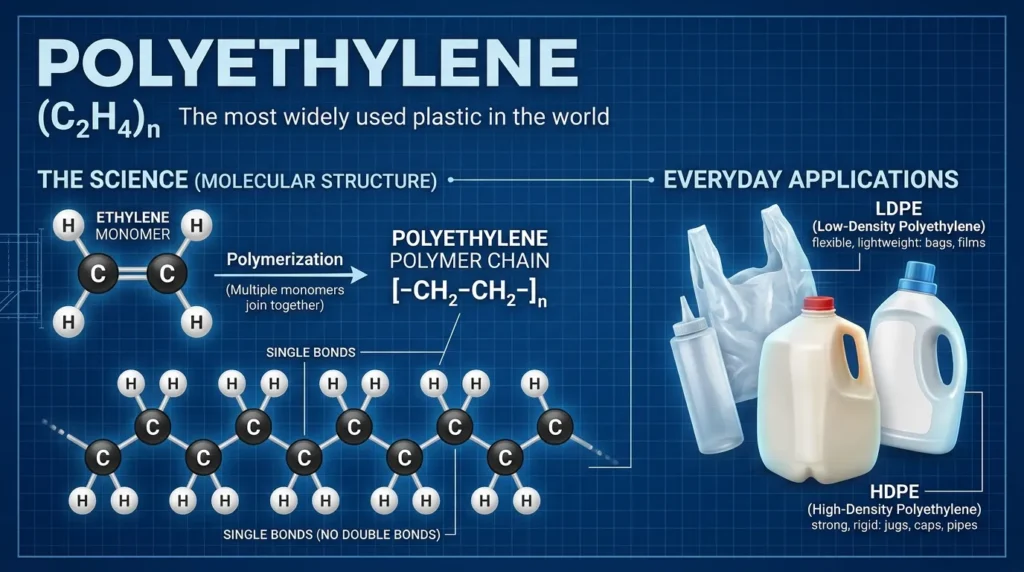
In simple words, polyethylene forms when many ethylene molecules join to create long chains. These chains give the plastic its useful features.
The word has two main parts:
- Poly: Means many.
- Ethylene: Refers to the small chemical molecule used to make this plastic.
So, polyethylene means a material made from many linked ethylene units.
Its common short form is PE. You may see this name on plastic packaging, product labels, and recycling information.
Polyethylene does not have just one form. Its structure can change during production. This affects its strength, density, flexibility, and other features.
How Is Polyethylene Made?
Polyethylene starts with a small molecule called ethylene. Manufacturers join many ethylene molecules through a chemical process called polymerization.
During this process, the small molecules form long chains. These chains create the plastic material we know as polyethylene.
Here is a simple look at the process:
- Get ethylene: Manufacturers obtain ethylene from hydrocarbon feedstocks.
- Start polymerization: They use heat, pressure, or special catalysts to help ethylene molecules join.
- Build long chains: The molecules form long polymer chains.
- Create plastic resin: Manufacturers process the material into small plastic pellets or other forms.
- Make products: Factories melt and shape the resin into bags, bottles, pipes, films, and other items.
Different production methods create different chain structures. This is why one type of polyethylene feels soft and flexible while another feels hard and strong.
The chemical formula for polyethylene is:
(C2H4)n
The letter n means that the number of repeating units can vary.
Main Types of Polyethylene
Not all polyethylene products have the same features. Manufacturers make different grades to meet different needs.
The main types include HDPE, LDPE, LLDPE, and MDPE. Their density and chain structure help determine how they behave.
High-Density Polyethylene (HDPE)
HDPE stands for high-density polyethylene. It has a more tightly packed chain structure than low-density polyethylene.
This makes it harder, stronger, and more rigid. It also offers good resistance to many common chemicals.
You can find HDPE in:
- Milk and water jugs
- Shampoo and detergent bottles
- Storage containers
- Plastic crates
- Water and drainage pipes
- Outdoor furniture
HDPE works well when a product needs to keep its shape. For example, a milk jug needs enough strength to hold liquid without bending too much.
Low-Density Polyethylene (LDPE)
LDPE means low-density polyethylene. Its polymer chains have more branches. These branches keep the chains from packing as closely together.
As a result, LDPE is soft, light, and flexible. It can bend without breaking easily.
Common uses include:
- Shopping bags
- Bread bags
- Food wrap
- Squeeze bottles
- Flexible packaging
- Trash bags
LDPE is useful when a product needs to bend, stretch, or fold. A soft plastic bag is a simple example.
LLDPE stands for linear low-density polyethylene. It has a mostly linear chain structure with short branches.
It offers a useful mix of strength and flexibility.
Manufacturers often use LLDPE for:
- Stretch film
- Agricultural films
- Plastic liners
- Flexible packaging
- Heavy-duty bags
LLDPE is common in packaging that needs to stretch around products and hold them in place.
MDPE means medium-density polyethylene. Its density falls between HDPE and LDPE.
It offers a balance of flexibility and strength. Manufacturers use it in some gas pipes, water pipes, fittings, and protective packaging.
MDPE can be a useful choice when a product needs more flexibility than some HDPE grades but more stiffness than LDPE.
Polyethylene Types Compared
The following table gives you a quick way to understand the main differences.
| Type | Main features | Common uses |
| HDPE | Hard, strong, and rigid | Milk jugs, pipes, detergent bottles |
| LDPE | Soft and flexible | Shopping bags, food wrap, liners |
| LLDPE | Flexible, strong, and stretchable | Stretch film, heavy-duty bags |
| MDPE | Balanced strength and flexibility | Gas pipes, water pipes, fittings |
The exact features can vary by grade and manufacturing method. A product’s design also affects its final strength and performance.
Important Polyethylene Properties
Polyethylene has several features that make it useful in homes and industries. However, not every grade has the same level of performance.
Here are its main properties.
1. Lightweight
Polyethylene weighs less than many common materials, such as steel and glass.
This makes it useful for packaging, containers, and products that people need to carry. A plastic bottle, for example, is often easier to transport than a glass bottle of the same size.
2. Water Resistance
Polyethylene does not dissolve in water. It also absorbs very little water under normal conditions.
This makes it useful for water containers, protective films, and pipes. However, the finished product must still have the right design and quality to prevent leaks.
3. Chemical Resistance
Many polyethylene grades resist common acids, bases, and other chemicals.
That is one reason manufacturers use HDPE for detergent bottles, chemical containers, and industrial pipes.
Still, resistance depends on the chemical, temperature, pressure, and plastic grade. Not every polyethylene product can safely hold every chemical.
4. Flexibility
Some polyethylene grades bend and stretch without breaking easily.
LDPE and LLDPE are good examples. Manufacturers use them in bags, wraps, and flexible films.
5. Electrical Insulation
Polyethylene does not conduct electricity well. This makes it useful as an insulating material in electrical wires and cables.
The insulation helps protect the conductor and reduce the risk of unwanted electrical contact.
6. Impact Resistance
Many polyethylene grades can handle bumps and knocks without cracking easily.
HDPE is often used in containers and storage products because of this feature. The exact level of impact resistance depends on the grade and temperature.
7. Low Cost and Easy Processing
Manufacturers can shape polyethylene into many forms. They can use processes such as extrusion, injection molding, and blow molding.
These methods help make films, pipes, bottles, lids, and other products in large quantities.
Common Polyethylene Uses in Daily Life
You may use polyethylene many times each day without knowing its name. It appears in many products because manufacturers can make it soft, hard, thin, or thick.
Here are some common examples.
Food Packaging
Manufacturers use polyethylene in food bags, freezer bags, plastic liners, and some food containers.
LDPE and LLDPE are common choices for flexible packaging. These materials help keep moisture out and protect products during storage.
Always check that packaging is designed for food contact. Not every plastic bag or film is suitable for food.
Plastic Bottles and Containers
HDPE is common in milk jugs, shampoo bottles, detergent bottles, and other household containers.
It offers a useful mix of strength, low weight, and chemical resistance. This helps containers hold liquids during storage and transport.
Water and Gas Pipes
Manufacturers use certain polyethylene grades to make water and gas pipes.
These pipes are light and flexible compared with many metal options. They can also resist corrosion.
However, pipe selection matters. The grade, pressure rating, wall thickness, and approved use must match the job.
Shopping and Trash Bags
Many shopping bags and trash bags contain LDPE, HDPE, or LLDPE.
HDPE often makes thin bags with good strength. LDPE makes softer bags, while LLDPE can provide useful stretch and tear resistance.
Toys and Household Products
Polyethylene can appear in toys, storage boxes, bins, cutting boards, and other household items.
HDPE works well for many hard products. Softer grades can serve products that need more flexibility.
Farming and Gardening
Farmers and gardeners use polyethylene films to cover soil, protect crops, and help manage moisture.
Some irrigation pipes and water storage products also use polyethylene. The right grade depends on outdoor exposure and the task.
Electrical Cables
Some electrical wires use polyethylene as insulation.
Its electrical properties make it useful in certain cable designs. Manufacturers choose the grade based on the cable’s voltage, temperature, and working conditions.
Advantages and Disadvantages of Polyethylene
Polyethylene offers many useful features, but it also has limits. Knowing both sides helps you understand why manufacturers choose it for some products and avoid it for others.
| Advantages | Disadvantages |
| Lightweight and easy to carry | Made mainly from fossil-based feedstocks |
| Resists water and moisture | Can add to plastic waste |
| Many grades resist common chemicals | Some grades can soften with heat |
| Easy to shape into different products | Can degrade after long exposure to sunlight unless protected |
| Useful for flexible and rigid products | Not all types are accepted by local recycling programs |
| Often costs less than some alternatives | Can persist in the environment when poorly managed |
Polyethylene can be a practical material, but it is not perfect. Its value depends on how people design, use, collect, and manage products made from it.
Is Polyethylene Safe?
Polyethylene is widely used in products that come into contact with food, water, and household items. However, safety depends on the grade, additives, manufacturing process, and intended use.
For example, a food container must meet the rules that apply to its intended use. A plastic bag made for shopping should not automatically be treated as food-safe packaging.
In the United States, the FDA lists food-contact substances and their authorized uses under specific rules. Manufacturers must follow the conditions that apply to their products.
Here are a few practical safety tips:
- Use containers marked as suitable for food storage.
- Follow the heating instructions on food packaging.
- Do not use damaged or badly worn food containers.
- Keep chemicals in containers designed for those chemicals.
- Follow the product label when storing or handling plastic items.
Does polyethylene contain harmful chemicals?
Pure polyethylene is made mainly from carbon and hydrogen. However, finished plastic products may contain additives, colors, stabilizers, or other ingredients.
So, the word polyethylene alone does not tell you everything about a finished product. Check its label and intended use before using it.
Is Polyethylene Recyclable?
Yes, many polyethylene products can be recycled. But the process depends on the type of plastic, the product design, local facilities, and collection rules.
Two common polyethylene recycling codes are:
- Number 2: High-density polyethylene (HDPE).
- Number 4: Low-density polyethylene (LDPE).
You may find these numbers inside a triangle on plastic packaging. They help identify the type of resin used to make the item.
However, there is one important point: a resin code does not guarantee that your local recycling program accepts the item. The U.S. Environmental Protection Agency advises people to check local recycling rules.
How Does Polyethylene Recycling Work?
The process can vary by facility, but it often follows these steps:
- Collection: Recycling programs collect accepted plastic products.
- Sorting: Workers or machines separate plastics by type.
- Cleaning: Facilities remove dirt, labels, and other unwanted materials.
- Shredding: Machines cut the plastic into small pieces.
- Processing: The clean material is melted and formed into new plastic feedstock.
- Manufacturing: Companies use the recycled material to make new products.
Not every polyethylene item follows this exact process. Some products contain mixed materials or food residue that make recycling harder.
Can You Recycle Plastic Bags?
Some plastic bags and flexible films contain LDPE or LLDPE. However, many curbside recycling programs do not accept them.
Some stores and specialist collection points accept clean, dry plastic bags and films. Check the rules before taking them there.
Never place plastic bags in a recycling bin unless your local program accepts them. They can cause problems in sorting equipment.
Polyethylene vs. Polypropylene: What Is the Difference?
People sometimes confuse polyethylene with polypropylene because both are common plastics. Both belong to a group called polyolefins, but they have different chemical structures and uses.
Polyethylene uses ethylene as its building block. Polypropylene uses propylene.
Here is a simple comparison:
| Feature | Polyethylene (PE) | Polypropylene (PP) |
| Building block | Ethylene | Propylene |
| Common products | Bags, milk jugs, pipes | Food tubs, caps, containers |
| Flexibility | Depends on the grade | Often stiff but can flex |
| Moisture resistance | Good | Good |
| Common resin code | 2 or 4 | 5 |
| Typical uses | Packaging and pipes | Food containers and household goods |
Neither material is always better. Manufacturers choose one based on the product’s needs, such as heat resistance, flexibility, strength, and cost.
Polyethylene vs. Polyethylene Terephthalate (PET)
These two names look similar, but they describe different plastics.
Polyethylene (PE) and polyethylene terephthalate (PET) are not the same material.
PE includes HDPE and LDPE. PET is a type of polyester that people often find in drink bottles, food containers, and other packaging.
You can often tell them apart by their resin codes:
- PE-HD: Number 2.
- PE-LD: Number 4.
- PET: Number 1.
This difference matters when sorting plastic waste. Putting the wrong plastic in a collection stream can make recycling more difficult.
Polyethylene Quick Reference Checklist
Use this table when you need to identify or understand a polyethylene product.
| What to check | What it tells you |
| PE label | The product uses polyethylene |
| Number 2 | The resin is HDPE |
| Number 4 | The resin is LDPE |
| Number 1 | The resin is PET, not PE |
| Soft and flexible feel | May indicate LDPE or LLDPE |
| Hard and rigid shape | May indicate HDPE |
| Food-safe label | Shows the product’s intended food-contact use |
| Local recycling rules | Tell you whether the item can be collected |
Remember that appearance alone cannot confirm the exact plastic type. Labels and manufacturer information provide better clues.
Why Is Polyethylene So Widely Used?
Polyethylene is popular because manufacturers can adjust its features to suit many products.
A soft plastic film and a hard storage container may look very different, yet both can contain polyethylene.
It also offers several practical benefits:
- It is light, which can help reduce product shipping weight.
- It resists water and moisture.
- It can be shaped into many forms.
- Some grades offer strong chemical resistance.
- It works in both flexible and rigid products.
- Manufacturers can produce it on a large scale.
Its wide range of uses makes it important in packaging, construction, farming, transport, and household goods.
Still, wide use creates a waste challenge. Better product design, less unnecessary packaging, reuse, and proper recycling all play a role in reducing plastic pollution.
FAQs:
1. What does polyethylene mean in simple words?
Polyethylene is a common type of plastic made from many linked ethylene molecules. It is lightweight, durable, and useful for making plastic bags, bottles, pipes, containers, and packaging.
2. Is polyethylene the same as plastic?
No. Polyethylene is one type of plastic. The word plastic describes a large group of materials, while polyethylene refers to a specific polymer within that group.
3. What are the four main types of polyethylene?
The four common types are HDPE, LDPE, LLDPE, and MDPE. Each type has different features. HDPE is generally harder, while LDPE is softer and more flexible.
4. Is polyethylene harmful to humans?
Polyethylene used in properly made products is widely used in food packaging and household goods. However, safety depends on the product’s ingredients, quality, and intended use. Always follow the manufacturer’s instructions.
5. What is polyethylene used for?
Manufacturers use polyethylene to make shopping bags, milk jugs, detergent bottles, food packaging, water pipes, electrical insulation, storage containers, and agricultural films.
6. What is the difference between HDPE and LDPE?
HDPE has a higher density and is generally harder and more rigid. LDPE has a lower density and is softer and more flexible. HDPE often makes bottles and pipes, while LDPE often makes bags and plastic films.
7. Is polyethylene biodegradable?
Regular polyethylene does not readily biodegrade under normal environmental conditions. It can remain in the environment for a long time. Reuse, proper waste collection, and suitable recycling can help reduce its impact.
Conclusion:
Polyethylene is a widely used plastic that makes many everyday products possible. Its meaning is simple: it is a polymer made from repeating ethylene units.
However, its different types have different features and uses. HDPE makes strong bottles and pipes, while LDPE and LLDPE work well for flexible packaging. Before choosing or recycling a polyethylene product, check its label and intended use. Also, follow local recycling rules rather than assuming every plastic item can go into the recycling bin.
Understanding this material helps you make better choices as a consumer.

Hey, I am passionate about exploring the English language and helping people understand the true meanings of words, phrases, and expressions. My interests include vocabulary, modern slang, word origins, everyday communication, and the different ways people use language. Through my work at Publarex.com, I aim to make complex words simple and easy to understand. My goal is to help readers learn something new with every article and use English with greater confidence.