
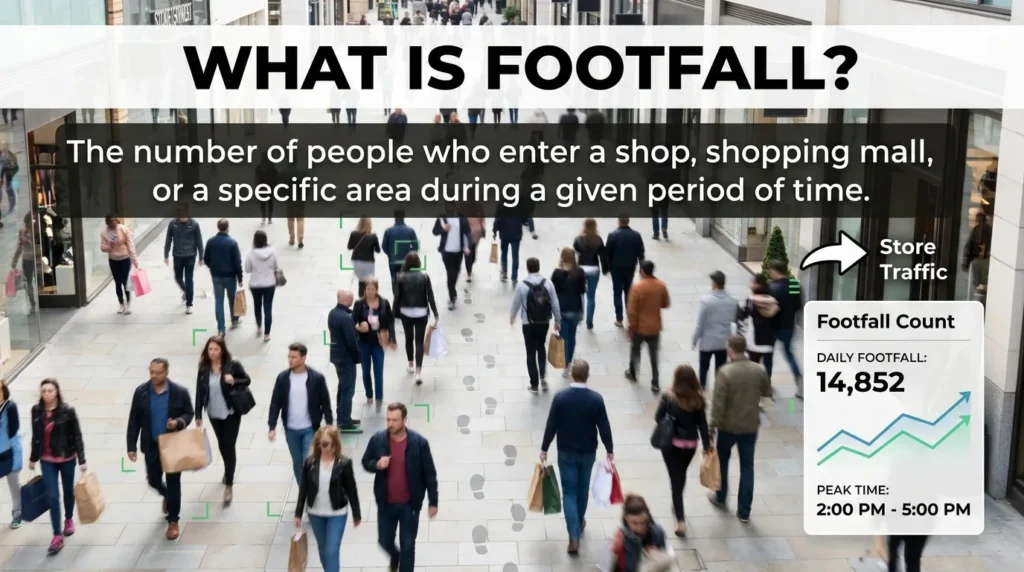

Quick Answer: Footfall means the number of people who visit a particular place during a specific period.
It is commonly used in retail, shopping malls, restaurants, events, and businesses to measure visitor traffic. For example, a store with high footfall receives many visitors, while a store with low footfall attracts fewer people.
Footfall Meaning
The footfall meaning refers to the number of people who enter or visit a particular place within a given time. Businesses use this word to understand how many visitors come to their physical locations.
For example, imagine a clothing store in a busy shopping mall. If 800 people visit the store in one day, its daily footfall is 800 visitors.
Footfall is an important term in retail, marketing, property management, tourism, and event planning. It helps business owners understand whether their location attracts enough people.
A high footfall usually means that many people visit a place. However, it does not always mean that the business makes more money. Some visitors may look around without buying anything.
In simple English, footfall means the number of people visiting a place, usually measured over a certain period.
What Does Footfall Mean in Business?
In business, footfall means the total number of people who visit a physical business location during a specific period. Companies use this information to measure customer visits and understand how busy their stores or offices are.
For example, a supermarket may record its footfall every day to compare weekday and weekend visits. If more people visit on Saturday, the manager can schedule extra employees to help customers.
Footfall data also helps businesses make important decisions, such as:
- Choosing a better location for a new store.
- Planning staff schedules during busy hours.
- Measuring the success of promotional campaigns.
- Understanding customer visiting patterns.
- Comparing visitor numbers across different branches.
Businesses often combine footfall data with sales figures. This helps them understand whether visitors are actually becoming paying customers.
For example, a store may receive 1,000 visitors but make only 50 sales. This information suggests that the business could improve its products, prices, customer service, or store layout.
What Is Footfall in Retail?
In retail, footfall refers to the number of people who enter a shop, supermarket, shopping center, or other retail location.
Retailers track footfall to understand how many potential customers visit their stores. This information can help them improve sales strategies and create better shopping experiences.
For example, a shoe shop may notice that its footfall increases during a holiday sale. The owner can use this information to prepare more stock and arrange additional staff.
Retail businesses also study footfall to understand which days and hours attract the most visitors.
A shopping mall may have high footfall during weekends because families and groups of friends often visit together. A small store inside the mall may receive only a portion of those visitors.
It is important to remember that footfall measures visits, not necessarily unique people. If one customer visits the same store three times in a week, those visits may be counted separately.
How Is Footfall Measured?
Footfall is measured by counting how many people enter a particular location during a selected period. Businesses can measure it manually or use digital counting systems.
Here are some common ways to measure footfall:
1. Manual counting: Employees stand near an entrance and count visitors as they enter. This method is simple but may become difficult in busy locations.
2. Door sensors: Electronic sensors detect people passing through an entrance. These systems automatically record visitor numbers.
3. CCTV analytics: Some businesses use camera-based systems to estimate how many people enter or move through a location.
4. Infrared counters: These devices detect movement across a doorway and help businesses count visitors.
5. Smart visitor systems: Advanced systems use digital technology to collect and analyze visitor traffic patterns.
The measurement period can be an hour, a day, a week, or a month. Businesses choose the period based on what they want to understand.
For example, a restaurant may track hourly footfall to identify its busiest lunch and dinner periods.
How to Use Footfall in a Sentence
The word footfall is commonly used when talking about visitors, shopping, businesses, public places, and customer traffic.
Here are 10 original examples showing how to use it in everyday and professional situations.
- Retail: Our clothing store experienced higher footfall after we launched the winter collection.
- Shopping malls: The shopping mall expects more footfall during the holiday shopping season.
- Business: The owner checks daily footfall to understand how many people visit the new branch.
- Marketing: Our latest social media campaign helped increase footfall at the physical store.
- Restaurants: The restaurant has strong footfall during Friday evening dinner hours.
- Workplace: The office manager noticed lower footfall because more employees started working remotely.
- Events: The technology exhibition attracted impressive footfall from visitors interested in AI products.
- Real estate: The agent recommended a shop near the main entrance because that area receives higher footfall.
- Everyday conversation: Footfall was surprisingly low at the shopping center this afternoon.
- Business reporting: The monthly report shows that footfall increased by 18% compared with September.
These examples show that footfall works well in both casual and professional conversations. It is especially useful when discussing how busy a physical location is.
Footfall vs. Traffic
Footfall and traffic are closely related words, but they do not always mean the same thing. Footfall usually counts people who visit a physical location, while traffic can describe the movement of people, vehicles, or online visitors.
| Word | Meaning | Example |
| Footfall | Number of people visiting a physical place | The store received 600 visitors today. |
| Traffic | Movement or flow of people, vehicles, or online visitors | The website received 10,000 visits. |
| Customer count | Number of customers served or recorded | The restaurant served 250 customers. |
| Visitor count | Number of people visiting a location | The museum recorded 400 visitors. |
For example, a shopping center may have high footfall because many people enter the building. However, its website traffic refers to people visiting its website rather than walking through its doors.
In short, footfall is mainly about physical visits, while traffic has a wider meaning.
Footfall in Texting and Slang
Footfall is not a popular slang word or internet abbreviation. It keeps its standard English meaning when people use it in text messages, social media posts, and online business discussions.
People may use it when talking about busy shopping areas, store performance, events, or customer visits. However, it sounds more professional than casual expressions such as “number of visitors” or “how many people came.”
Here are three chat-style examples:
Example 1: Talking about a shop
Alex: Was your store busy today?
Sam: Yes, we had great footfall after lunch.
Example 2: Discussing an event
Mia: How was the weekend tech event?
Ryan: Really good! The footfall was much higher than expected.
Example 3: Business conversation
Noah: Why are we getting fewer customers this month?
Ella: Our footfall has dropped since the road construction started.
On social media, businesses may also use the word in posts about store openings, special offers, and promotional events.
Why Is Footfall Important for Businesses?
Footfall helps businesses understand how many people visit their physical locations. This information can reveal patterns that are difficult to notice by looking at sales figures alone.
For example, a shop may receive many visitors but generate fewer sales. Another shop may receive fewer visitors but convert more of them into customers.
By studying footfall, businesses can identify opportunities to improve their performance.
Better staff planning: Managers can schedule more employees during busy periods and reduce staffing during quieter hours.
Improved store locations: Business owners can compare different areas before opening a new branch.
Marketing performance: Companies can check whether advertisements, discounts, and special events bring more people into their stores.
Customer experience: Visitor patterns can help businesses identify crowded entrances, long queues, and areas that need improvement.
Sales analysis: Comparing footfall with sales helps businesses understand how effectively they turn visitors into paying customers.
One useful measurement is the footfall conversion rate.
For example, if 500 people visit a store and 75 make a purchase, the conversion rate is 15%.
This shows why footfall and sales should be studied together rather than treated as the same measurement.
What Is the Difference Between High and Low Footfall?
High footfall means that a location receives many visitors during a particular period. Low footfall means that fewer people visit the location during that same period.
Both can affect business performance in different ways.
A shopping center with high footfall may have more opportunities to attract customers. However, high visitor numbers do not guarantee strong sales or profits.
A small shop with low footfall may still perform well if its visitors are interested in its products and make regular purchases.
Here is a simple comparison:
| High Footfall | Low Footfall |
| More people visit the location. | Fewer people visit the location. |
| There may be more potential customers. | There may be fewer potential customers. |
| Busy periods may require extra staff. | Fewer employees may be needed at quiet times. |
| Common in popular shopping areas. | Common in less busy or remote locations. |
Businesses should not judge success by visitor numbers alone. They should also consider customer interest, sales, expenses, and overall performance.
FAQs:
1. What does footfall mean in simple words?
Footfall means the number of people who visit a place during a certain period. For example, if 300 people enter a store in one day, its daily footfall is 300.
2. What does footfall mean in business?
In business, footfall refers to the number of visitors entering a physical business location. Companies use it to understand customer visits, plan staff schedules, and measure the performance of their stores.
3. What does footfall mean in retail?
In retail, footfall means the number of people who enter a shop, supermarket, or shopping mall. Retailers track it to understand visitor patterns and improve their sales strategies.
4. Is footfall the same as traffic?
No, although the words are related. Footfall usually refers to people visiting a physical place, while traffic can describe physical movement or visits to a website.
5. What is an example of footfall?
If 750 people enter a shopping mall on Monday, the mall has a daily footfall of 750 visits. Businesses can compare this number with other days to understand visitor patterns.
6. What does high footfall mean?
High footfall means that many people are visiting a particular location during a specific period. It can create more opportunities for businesses to attract customers, although it does not guarantee higher sales.
7. What is low footfall?
Low footfall means that fewer people are visiting a place than expected or compared with another period. It may happen because of poor location, bad weather, limited promotion, or changes in customer habits.
Conclusion:
Footfall means the number of people who visit a physical place during a specific period.
It is widely used in retail, business, shopping malls, restaurants, and event planning to measure visitor activity.
Remember that footfall counts visits, not necessarily purchases or unique individuals. When you see this word, think of the number of people walking into a place.

Hey, I am passionate about exploring the English language and helping people understand the true meanings of words, phrases, and expressions. My interests include vocabulary, modern slang, word origins, everyday communication, and the different ways people use language. Through my work at Publarex.com, I aim to make complex words simple and easy to understand. My goal is to help readers learn something new with every article and use English with greater confidence.